This post may contains affiliate links. Read our full disclosure here.
When I moved into my first apartment in Los Angeles, the living room was so small that my sofa technically touched two walls. I spent a long time thinking the solution was to get less furniture. It wasn’t. The real solution was learning how to use the space I actually had — and the right small living room decorating ideas changed everything. A small living room doesn’t need to feel cramped, compromised, or like a waiting room. With the right furniture layout, some strategic visual tricks, and a color palette that works with your dimensions rather than against them, a compact living room can feel intentional, cozy, and genuinely beautiful. Here’s everything that actually works.
Start With the Floor Plan: Furniture Layout Comes First
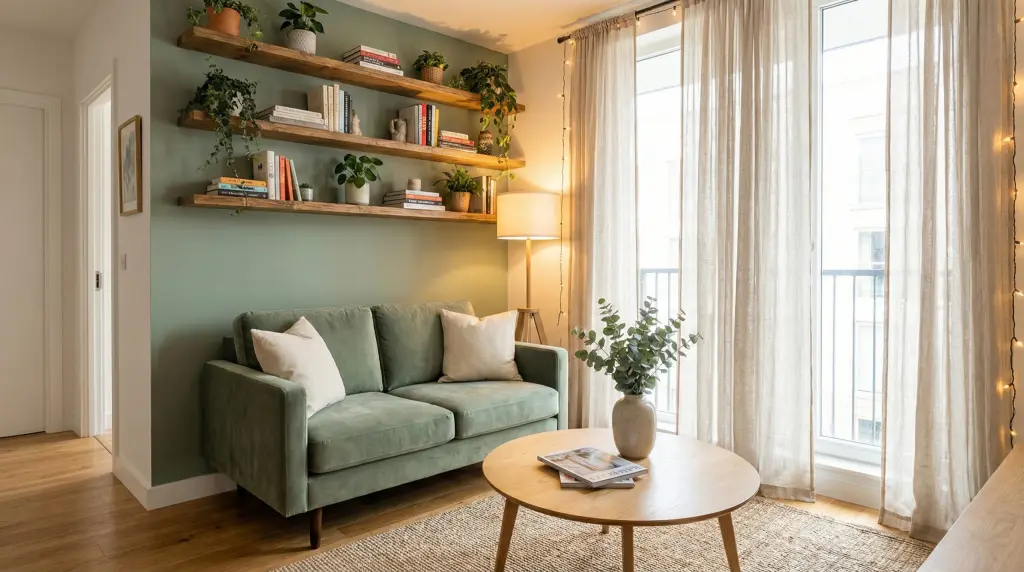
Every great small living room decorating idea starts with the floor plan, not the furniture. The biggest mistake people make in small living rooms is buying furniture first and then trying to make it fit. Measure your room before you buy anything, and sketch out a rough floor plan — even on graph paper. This sounds obvious but it will save you from that brutal moment when the sofa you drove three hours to pick up won’t clear the doorframe.
The Floating Furniture Rule
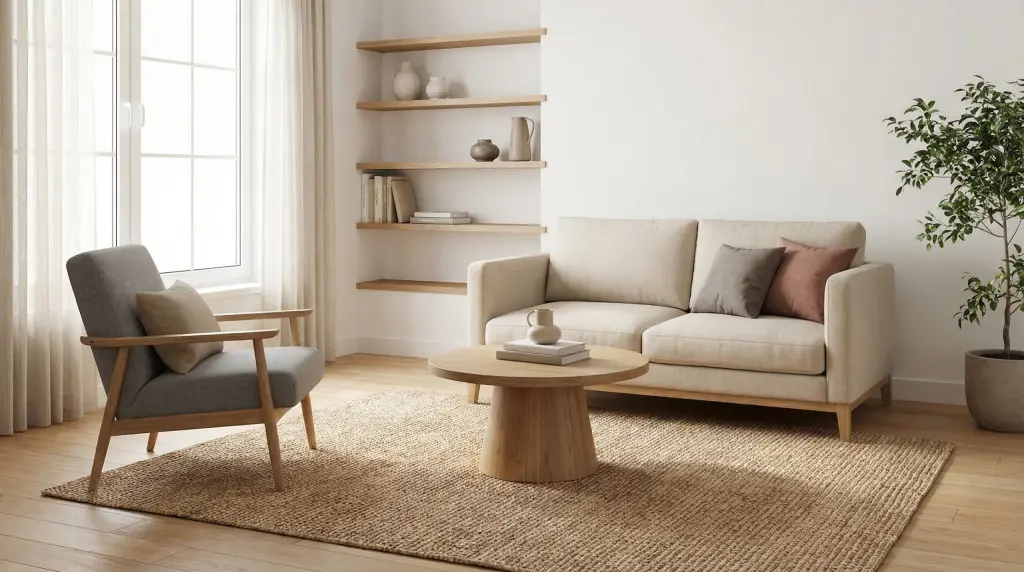
The instinct in a small living room is to push all the furniture against the walls to “free up” the center. This almost always backfires. When furniture lines the walls, the room looks like a waiting room — and the center of the space feels empty and awkward rather than open. Instead, try floating your seating a few inches away from the walls, even just 6–12 inches. It creates a sense of depth and makes the room feel more intentional. A round coffee table in the center of a small seating arrangement is one of my favorite small living room ideas — no sharp corners means easier movement, and the curved shape keeps the space feeling fluid.
Choose a Loveseat Over a Full Sofa (Usually)
A full three-seater sofa in a genuinely small living room will dominate the space and leave room for almost nothing else. A loveseat plus one good armchair — angled slightly toward each other around a round or oval coffee table — gives you just as much seating, creates a more intimate and designed feeling, and leaves actual breathing room in the room. TOV Furniture makes some beautiful compact loveseats and armchairs with clean lines that work especially well in small living rooms — their pieces are designed to look proportionate without reading as “small furniture.”
Define the Zone With an Area Rug
An area rug is non-negotiable in a small living room. It anchors the seating zone visually, defines the conversation area, and makes the whole arrangement look considered rather than accidental. The rug should be large enough that the front legs of all seating pieces sit on it — the common mistake is going too small. In a compact space, a rug that’s too small just floats awkwardly in the center. A 5×8 or 6×9 area rug is usually the right range for a typical small living room.
One more layout note: think vertically. Floor-to-ceiling bookshelves, tall plants, and art hung slightly higher than standard all draw the eye upward and make ceilings feel higher. I used this same trick in my entryway decor and it doubled how spacious the hallway felt.
Make It Feel Bigger: Visual Tricks That Actually Work
There’s a whole category of small living room decorating ideas that don’t add square footage but absolutely make your space feel larger. These are my most-used ones.
The Mirror Rule
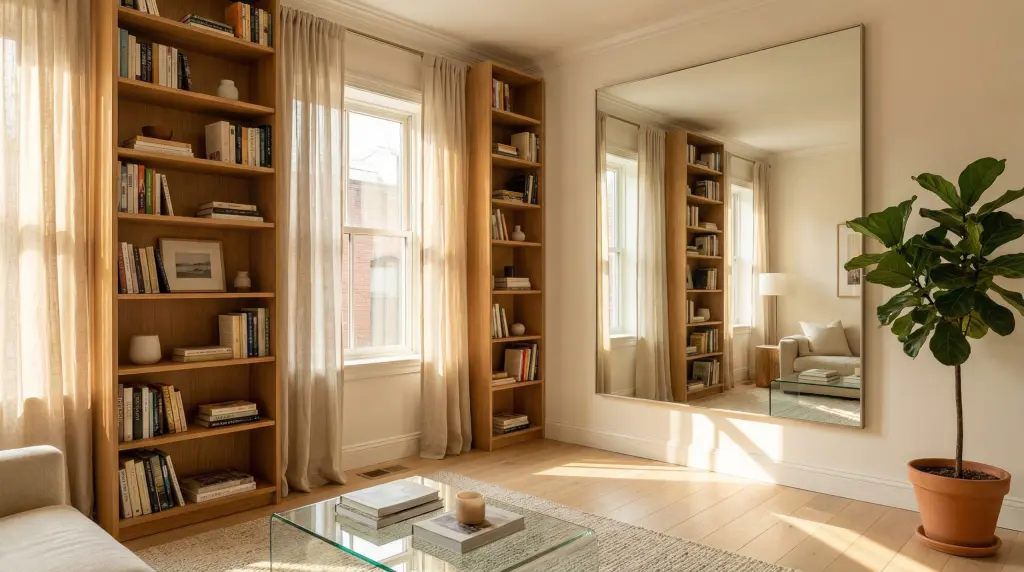
A large wall mirror — and I mean actually large, not a decorative accent mirror — is one of the most reliable tools in a small living room. It doubles the perceived depth of the space, reflects light, and creates the illusion of a room that continues beyond the wall. Place it on the wall opposite your main light source (usually a window) for maximum effect. I prefer a mirror with a simple frame over an elaborate one in a small room — ornate frames call attention to themselves while a clean frame just lets the reflection do the work. A large leaning floor mirror is also a great option if you don’t want to commit to wall hardware.
Hang Curtains High and Wide
This is one of the highest-impact, lowest-cost small living room ideas out there. Install your curtain rods close to the ceiling — not just above the window frame — and extend the rod 8–12 inches past each side of the window. When the curtains hang from ceiling height, your eye reads the full wall height as window height. The room feels taller and the windows feel larger. Use light, sheer fabric rather than heavy drapes to keep the space feeling airy rather than closed in.
Go Leggy With Furniture
Furniture that sits directly on the floor blocks your line of sight and makes a small room feel more crowded than it is. Furniture with legs — even a few inches of clearance — lets light and sight travel under the pieces, which makes the room feel less dense. This applies to sofas, armchairs, and even side tables. The same principle applies to a glass or lucite coffee table: it takes up floor space but doesn’t visually occupy it, which is why glass coffee tables are a classic small living room decorating idea.
The goal in a small living room isn’t to make people forget it’s small. It’s to make them feel so comfortable they stop thinking about square footage altogether.
One Statement Piece, Not Five
In a small living room, a single bold piece — one great rug, one beautiful piece of art, one striking lamp — reads as intentional and confident. Five competing statement pieces just read as cluttered. Pick your one hero item and let everything else support it. For art in a small living room, I tend to go bigger than feels comfortable — one large print or canvas on a wall looks more deliberate than a collection of small frames that fight for attention. Art.com has a huge selection of oversized prints at reasonable prices, and they ship with hanging hardware included.
Color Palette for Small Living Rooms
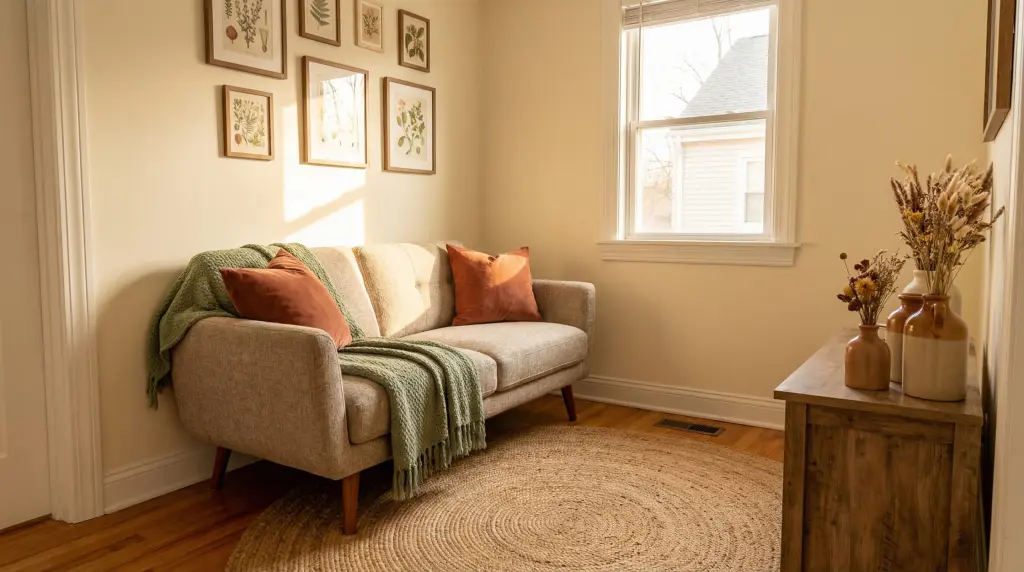
Color is one of the most discussed aspects of small living room decorating, and also one of the most misunderstood. The conventional advice is “paint it white.” That advice isn’t wrong — light walls do reflect more light and make a space feel open — but it’s also not the whole story. Painting a small living room a deep, moody color can actually make it feel more intentional and cozy rather than cramped, provided you handle the contrast and lighting correctly.
The Safe Bet: Warm Neutrals
If you want the most universally successful palette for a small living room, warm neutrals are it. Cream, ivory, warm white, greige, and soft linen tones reflect light without the cold sterility of a stark white. Add warmth through texture — a jute or wool rug, linen throw pillows, a woven blanket — rather than through dark or heavy color. This creates a room that feels light, airy, and layered at the same time. The approach is similar to what I explored in my piece on warm minimalism — neutrals don’t have to be cold or impersonal.
The Accent Wall Play
If you want to add color to a small living room without overwhelming it, the accent wall remains one of the most reliable strategies. The key is choosing the right wall: the wall behind your main seating (the “sofa wall”) is typically the best candidate because it recedes visually and gives the color a natural backdrop. Sage green, dusty blue, warm terracotta, and deep forest green all work beautifully as accent colors in small living rooms right now. These tones are warm enough to feel cozy but muted enough not to close in the space.
Bold Dark Walls: When It Works
Painting a small living room a deep charcoal, forest green, or navy sounds counterintuitive but can be stunning when done right. The trick is consistency: if you go dark on the walls, keep the ceiling lighter (usually the same color but two shades lighter, or just white), choose furniture in lighter upholstery tones, and layer in strong lighting. A dark-walled small living room that’s well-lit feels like a jewel box — intimate, intentional, and enveloping rather than cramped.
Whatever palette you choose, keep the color story to three or four tones maximum. A neutral base, one accent color, and one or two texture tones (wood, metal, textile) is the formula that works every time in a small living room. More than that and the space starts to feel restless rather than curated.
Smart Storage That Doesn’t Look Like Storage
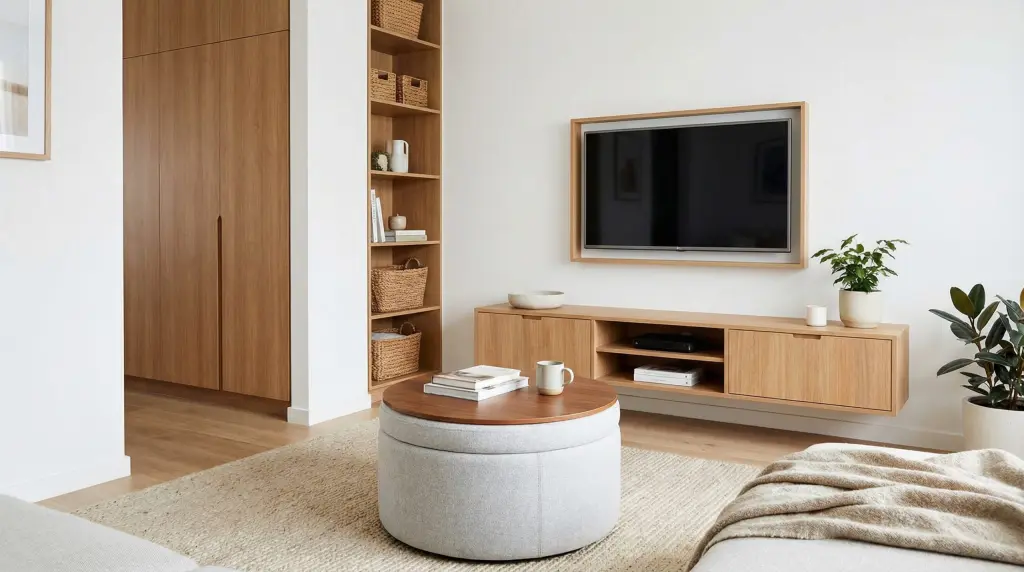
Clutter is the enemy of a beautiful small living room. Not because minimalism is the goal, but because visual noise in a compact space gets amplified in a way it doesn’t in a larger room. The solution isn’t to own less — it’s to store smarter. (I went deep on the whole-house version of this in my guide to declutter your home — the same principles apply here.)
The Storage Ottoman: Your New Coffee Table
Swapping a traditional coffee table for a storage ottoman is one of the best small living room ideas I’ve ever put into practice. You get the same surface area (especially with a tray on top), plus a hidden interior that can hold throws, remotes, magazines, board games, whatever tends to accumulate in your living room. A storage ottoman also softens the room because upholstered pieces feel less hard-edged than a coffee table, which is especially welcome in a compact space.
Built-Ins and Wall-Mounted Everything
In a small living room, floor space is precious real estate. Every piece of furniture that sits on the floor competes for that real estate. The solution is to move as much as possible off the floor and onto the walls: floating shelves, wall-mounted media consoles, wall-mounted side tables, and built-in cabinetry that goes floor to ceiling. Built-ins in particular are transformative — they create storage without the visual bulk of freestanding furniture, and a floor-to-ceiling built-in draws the eye upward and adds architectural interest at the same time. RC Willey has a wide range of wall-unit entertainment centers and modular shelving that work well in small living rooms without requiring a custom build budget.
The Rule of Hidden vs. Display
Not everything in a small living room needs to be put away — curated display is part of what makes a space feel lived-in and personal. The key is the 60/40 rule: roughly 60% of your shelving and storage should be hidden (behind cabinet doors, in drawers, inside ottomans) and 40% can be open display. When you flip that ratio — too much on display, not enough hidden — a small living room starts to feel cluttered even when nothing is actually messy. I use this same approach in my linen closet organization system — visible vs. hidden is the whole game.
Lighting Your Small Living Room Right
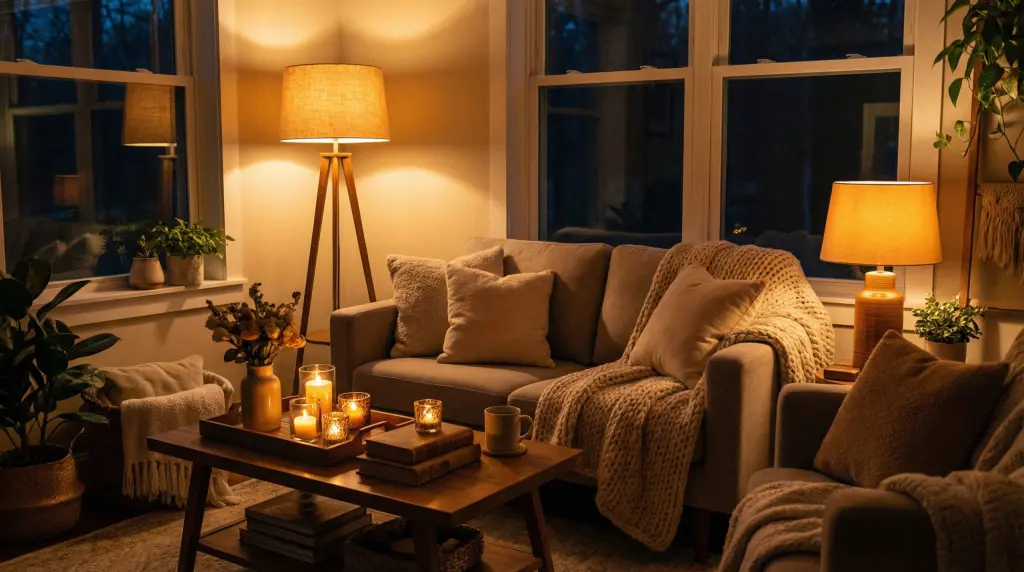
Lighting is the most underrated element of small living room decorating. Most people rely entirely on an overhead ceiling fixture and wonder why the room feels flat and unappealing in the evenings. The fix is layered lighting, and it makes a bigger difference than almost any piece of furniture.
The Three-Layer Formula
- Ambient (overhead): Your ceiling light or recessed fixtures. This is the foundation layer but should rarely be used alone in the evening — overhead light from a single source flattens a room and creates harsh shadows.
- Task lighting: Floor lamps and table lamps placed at eye level when seated. This is the warm, golden light that makes a living room feel inviting. A floor lamp beside the sofa and a table lamp on a console or end table are the minimum.
- Accent lighting: The finishing layer. This includes picture lights, under-shelf strip lighting, and candles. In a small living room, accent lighting adds depth and dimension — it creates areas of warm glow and shadow that make the room feel larger and more atmospheric.
Warm Bulbs Only
In a small living room, bulb temperature matters enormously. Cool white or daylight bulbs (5000K+) look clinical and emphasize the hard edges of a small space. Warm white bulbs (2700K–3000K) create the soft, golden glow that makes any room feel cozy and welcoming. Replace every bulb in your living room with warm white and the room will feel different before you move a single piece of furniture. It’s the highest-effort-to-reward ratio of any small living room idea I know.
Use Dimmers
If you’re doing one hardware upgrade for your small living room, put a dimmer switch on your overhead fixture. Being able to drop the overhead light to 20% in the evening — while your floor and table lamps carry the room — completely changes how the space feels. It’s the difference between a small living room that looks like an apartment and one that feels like a home. The same principle I use in my spring bedroom refresh — lighting is always about layering, never about a single source.
FAQ
What is the best furniture arrangement for a small living room?
Float your seating a few inches away from the walls rather than pushing everything to the perimeter. A loveseat and one armchair around a round or oval coffee table is the most space-efficient and visually comfortable arrangement for most small living rooms. Define the seating area with an area rug large enough for the front legs of all seating pieces to sit on it.
What colors make a small living room look bigger?
Warm neutrals — cream, ivory, warm white, and greige — reflect the most light and make a small living room feel open without feeling cold. Lighter walls with a warm-toned accent wall (sage green, dusty blue, soft terracotta) also work well. Contrary to popular belief, dark colors can work in a small living room if the lighting is strong and the furniture is lighter in tone.
Should I use a rug in a small living room?
Yes — absolutely. An area rug is one of the most important elements in a small living room because it defines the seating zone and makes the arrangement look intentional. The common mistake is choosing a rug that’s too small. In most small living rooms, a 5×8 or 6×9 rug is the right size — large enough for the front legs of all seating pieces to sit on it.
How do I make a small living room feel cozy without making it feel cluttered?
Texture is your best friend here. Layer soft textiles — a throw blanket, cushions in two or three complementary fabrics, a plush rug — rather than adding more objects. Keep the 60/40 storage rule in mind: 60% hidden storage, 40% open display. And use warm lighting: floor and table lamps at eye level rather than relying on overhead ceiling light.
What size coffee table works best in a small living room?
A round or oval coffee table is almost always the best choice for a small living room. No sharp corners means easier movement through the space, and curved shapes keep the room feeling fluid rather than rigid. For size, the coffee table should be roughly two-thirds the length of your sofa and low enough that the surface is slightly below the sofa cushions. A storage ottoman in place of a coffee table is another excellent option — it serves the same function while also providing hidden storage.
How do I add storage to a small living room?
Move storage off the floor and onto the walls wherever possible. Floating shelves, wall-mounted media consoles, and floor-to-ceiling built-ins free up floor space while adding visual height. Replace a traditional coffee table with a storage ottoman. For the open shelving, keep the 60/40 rule in mind — a mix of hidden storage (behind cabinet doors) and curated open display keeps the room feeling organized without looking sterile.
A small living room done well isn’t a consolation prize for a bigger one. Some of the most beautiful, most livable rooms I’ve ever been in have been small. They just required a little more intention — a cleaner layout, smarter storage, better lighting, and a color palette that worked with the architecture rather than against it. That’s all small living room decorating really is: intention applied consistently. Get the floor plan right, add a mirror, pick one statement piece, layer your lighting, and you’ll be amazed what a compact room can become.