This post may contains affiliate links. Read our full disclosure here.
A botanical print gallery wall is one of those decorating ideas that looks expensive, feels considered, and is genuinely approachable to pull off — even if you’ve never hung more than a single frame in your life. The combination of art and nature has been a staple of interior design for centuries, and right now, the botanical print gallery wall is having a serious moment. From tight grid arrangements in black frames to loose salon-style mixes on sage green walls, botanical gallery walls show up in every aesthetic from warm minimalism to maximalist cottagecore. This guide covers everything: why botanical prints work so well as wall art, how to plan and hang a gallery wall without the stress, the layouts that look most intentional, and where to find beautiful prints at every price point.
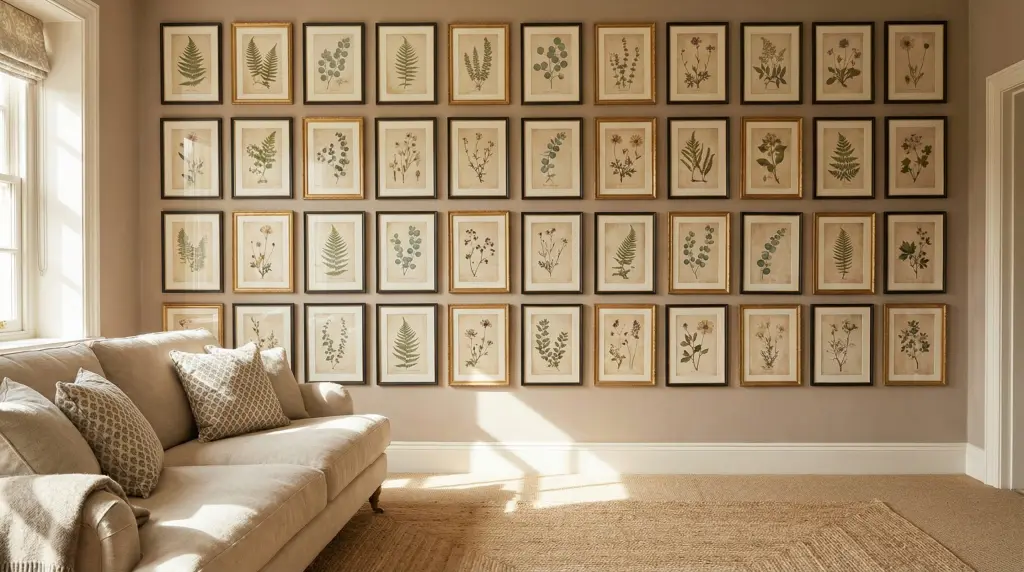
Why Botanical Prints Work So Well as Gallery Wall Art
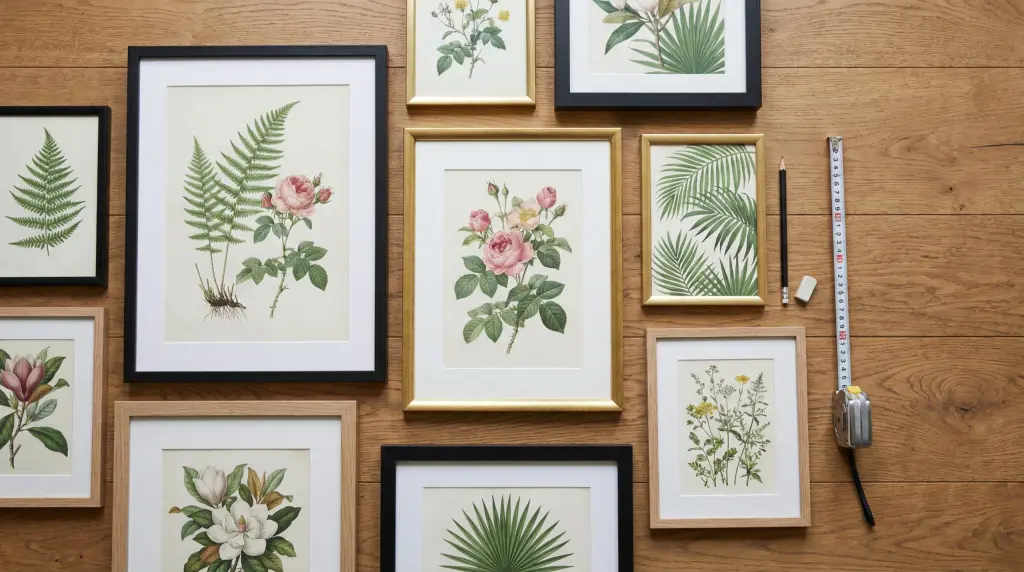
I’ve helped a lot of friends style their walls over the years, and I keep coming back to botanical prints as a recommendation for one simple reason: they’re the rare type of art that almost never looks wrong. There’s a reason botanical illustration has been collected for 400 years. Antique botanical prints from the 17th and 18th centuries — the kind produced for scientific herbals and natural history collections — were some of the most prized objects in educated households. The tradition continued through Victorian pressed flower art, the Arts and Crafts movement’s love of naturalistic illustration, and now into the contemporary home.
They Bridge Every Aesthetic
Botanical prints work across interior styles in a way that few other art types do. A clean black-and-white fern print looks perfectly at home in a modern, minimal space. The same image in a warm gold frame on a cream wall reads as traditional and collected. A loose watercolor botanical in a mismatched vintage frame belongs in a bohemian or cottagecore room. A formal copperplate engraving of medicinal herbs suits a library or study. This versatility is the core appeal of the botanical print gallery wall: you can make it look like yours, whatever your style.
Nature Brings Calm
There’s genuine research linking visual exposure to natural imagery with reduced stress and improved mood — the same principle that makes having real plants in a space feel good. A botanical print gallery wall brings that calming, grounding quality of nature indoors even in rooms where a living plant collection isn’t practical. It’s a design choice with a real psychological payoff, not just a visual one. This is part of why botanical gallery walls work particularly well in bedrooms, bathrooms, home offices, and other rooms where you want the atmosphere to feel settled and quiet.
They Age Well
Trends move fast in interior design, but botanical prints are genuinely timeless. The same print you hang today will still look right in fifteen years, in a different house, with different furniture around it. That makes investing in a good set of botanical prints or a single beautiful oversized piece a different kind of decision than most decorating purchases. Unlike trend-driven art, botanical prints hold their relevance. I think of them the way I think about quality linen or a good wool throw: an investment that ages gracefully.
A botanical print gallery wall is one of the few decorating decisions I’ve never seen anyone regret. It’s the kind of thing that looks better the longer you live with it.
How to Plan a Botanical Print Gallery Wall
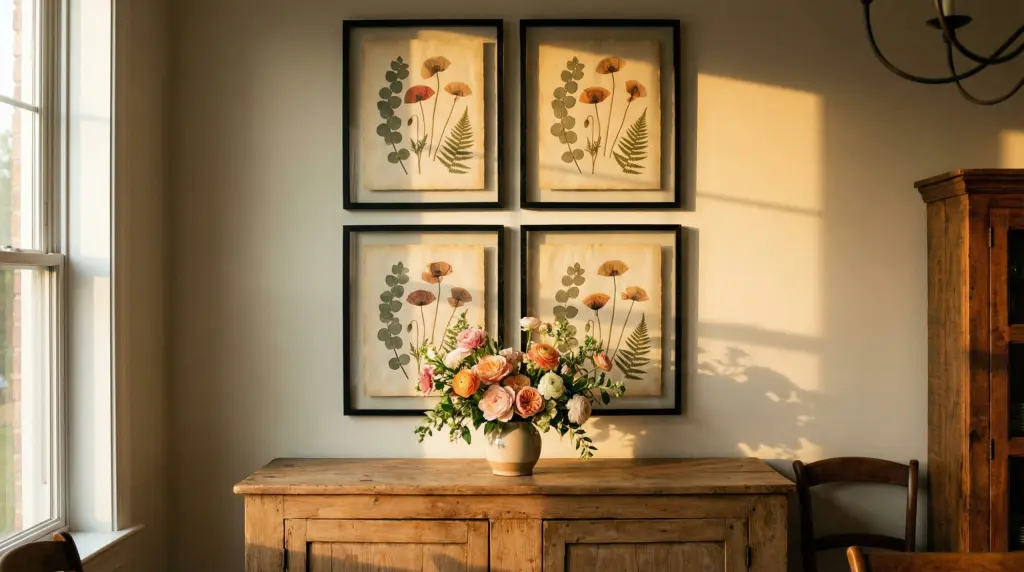
The planning stage is where most people either save themselves a lot of frustration or create it. A botanical print gallery wall that looks effortless usually had a lot of thought put into it before a single nail went into the wall. Here’s the process I use.
Step 1: Define Your Wall Space
Start by measuring the wall space where your botanical gallery wall will live. Note the width and height available, and any furniture below it (a sofa, sideboard, bed, or console table) that will anchor the arrangement visually. The gallery wall should relate to that anchor piece — generally, it should be roughly the same width as or slightly narrower than the furniture below it, and it should start no lower than 6–8 inches above the top of the furniture. If you’re working with an empty wall (no furniture anchor), the center of the gallery arrangement should hang at eye level, which is typically around 57–60 inches from the floor to the center of the grouping.
Step 2: Choose Your Frame Style
This is the decision that most affects the overall look of a botanical print gallery wall. You have two broad approaches:
- Matching frames: Same frame finish and width throughout. Creates a cohesive, formal, editorial look. Works best for grid arrangements and symmetrical layouts. Black, gold, natural wood, and white are the most versatile finishes.
- Mixed frames: Different finishes, sizes, and styles intentionally combined. Creates a collected, personal, salon-style look. Works best for eclectic or bohemian spaces. The key to making mixed frames look intentional rather than random: limit your palette to 2–3 finishes (e.g., black + natural wood, or gold + antique bronze).
For a first botanical gallery wall, matching frames are more forgiving. A set of matching black or natural wood frames in 3–4 sizes gives you the flexibility to create different arrangements while maintaining visual cohesion. A gallery wall frame set that includes multiple sizes in a single finish is one of the easiest ways to get started.
Step 3: Lay It Out on the Floor First
Before you touch a hammer, lay all your frames on the floor in the arrangement you’re considering. This is the single most useful step in planning a botanical print gallery wall, and the one most people skip. Seeing the arrangement at scale lets you adjust spacing, try different configurations, and spot problems (a gap that’s too wide, a size that disrupts the balance) before you’ve committed anything to the wall.
Step 4: Transfer to the Wall
Once you’re happy with the floor arrangement, trace each frame on a piece of paper or craft paper, cut them out, and tape them to the wall in your planned arrangement. Walk away, come back with fresh eyes, and look at it from the doorway. Adjust spacing if anything feels off. When you’re happy, mark the nail positions through the paper templates. Adhesive picture hanging strips are a good alternative for lighter frames if you want to avoid nails entirely — particularly useful in rentals or on plaster walls.
Spacing Rules
- For a tight, formal grid: 2–3 inches between frames
- For a relaxed, editorial arrangement: 3–5 inches between frames
- For a loose, salon-style grouping: 4–8 inches (more variation is fine)
- Consistent spacing within a section reads as intentional; erratic spacing reads as accidental
Botanical Print Gallery Wall Layouts That Actually Work
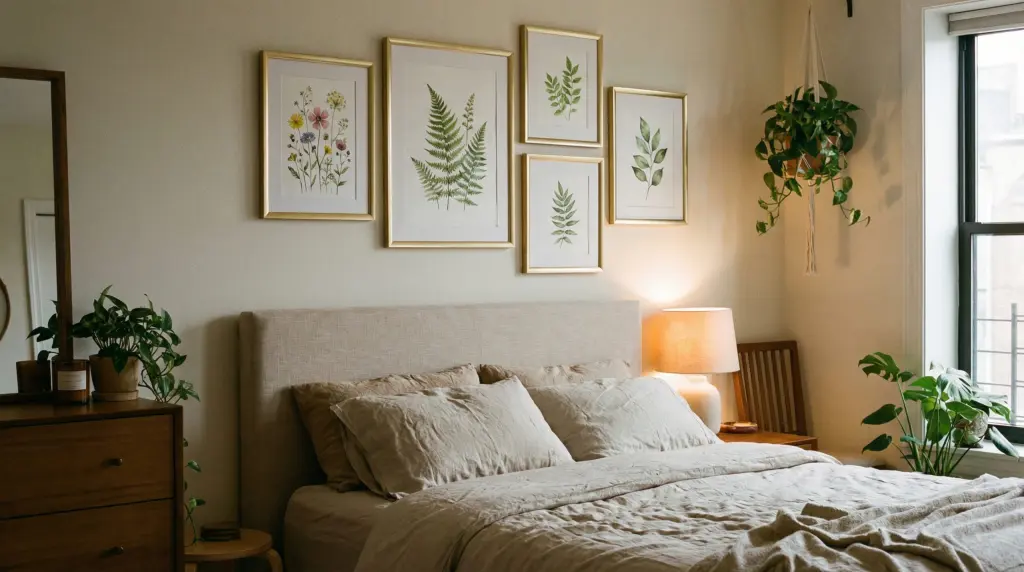
Not all gallery wall layouts are equal, and some work much better for botanical prints than others. Here are the formats I come back to most often.
The Tight Grid
A grid of identically-sized frames with consistent 2–3 inch spacing is the most formal and architectural of all botanical gallery wall layouts. It works best with matching frames (typically thin black or gold metal) and prints that have a consistent visual weight — all line drawings, or all color illustrations, or all black-and-white photography. A 2×2, 2×3, or 3×3 grid works well for most wall sizes. The tight grid rewards investment in good matting — a wide white mat around each print adds visual breathing room and elevates the overall look significantly. This is my go-to layout for dining rooms and hallways, where the formality is at home.
The Horizontal Row
Three to five prints in a single horizontal row is one of the most versatile botanical gallery wall formats for above-furniture placement. It sits naturally above a sofa, sideboard, or console table, and the horizontal emphasis reinforces the furniture below it. Using prints of the same height but slightly varying widths (or all the same size) keeps the arrangement clean. A horizontal row of three large-format botanical prints in matching frames is one of the most impactful and simplest gallery wall arrangements you can create.
The Staircase Diagonal
For stairwells and stair walls, a diagonal arrangement that follows the angle of the stairs is the most practical and visually satisfying approach. Keep the center of each frame at a consistent height above the corresponding stair tread, and maintain consistent spacing between frames. Botanical prints work particularly well on stair walls because the scale of the wall (often tall and narrow) suits a vertical procession of individual prints, and the botanical theme adds warmth and interest to what might otherwise be a purely transitional space.
The Salon Wall
A salon-style arrangement — a loose, layered grouping of frames at varying sizes, orientations, and heights — is the most expressive and personal of all botanical gallery wall formats. It works best in living rooms, home offices, and bedrooms where an eclectic, collected feeling is welcome. The key rules for making a salon-style botanical gallery wall look intentional rather than chaotic: anchor it with 1–2 larger pieces that establish the visual center of gravity, maintain a consistent frame palette (2–3 finishes maximum), and keep the outer edges of the arrangement roughly aligned. A completely random arrangement will look random; a loose arrangement with a clear anchor and roughly defined edges looks curated.
Whatever layout you choose, the same principle I use for spring mantel styling applies here: restraint is usually more interesting than abundance. A well-spaced arrangement of fewer, well-chosen prints almost always looks better than a crowded wall.
Room-by-Room: Botanical Gallery Wall Ideas
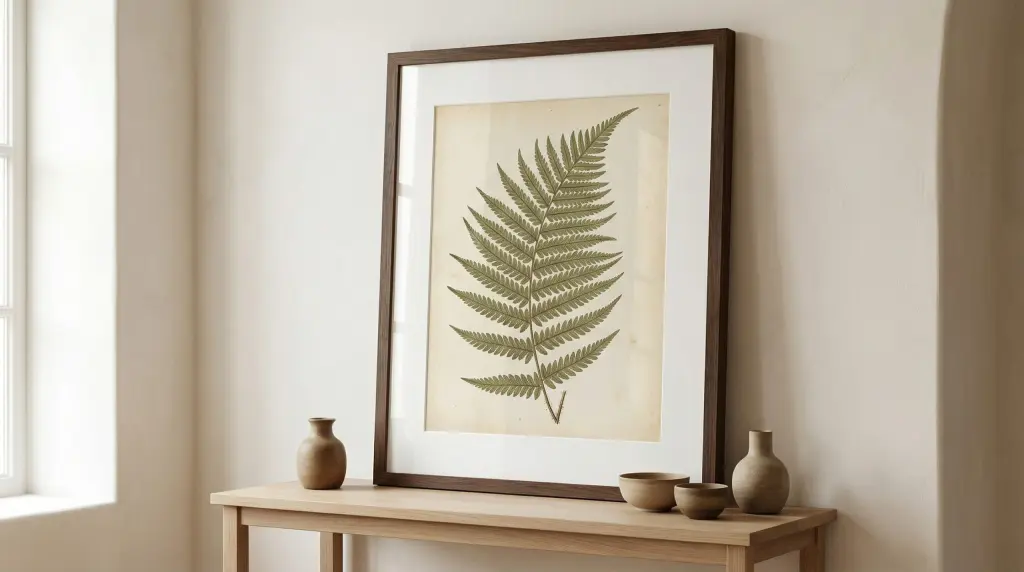
The best botanical gallery wall idea for any given room depends on the room’s function, scale, and existing aesthetic. Here’s how I approach each room.
Living Room
The living room is the most common home for a botanical print gallery wall, and for good reason — it’s typically the largest wall in the home and the room that most benefits from a visual focal point. For a living room botanical gallery wall, I lean toward arrangements that center on the sofa wall, use slightly larger prints than you think you need (art almost always looks smaller on a wall than it does in a store), and include at least one or two prints that are genuinely interesting up close as well as from across the room. The combination of scale and detail is what makes a living room gallery wall feel rich rather than just decorative. My broader guide to small living room decorating ideas has more on how to use art to change the perceived scale of a room.
Bedroom
A botanical gallery wall above the headboard is one of my favorite bedroom decorating ideas. It replaces the headboard as the visual anchor of the room while adding layers of texture and personality. For a bedroom botanical print gallery wall, I favor softer tones — botanical watercolors in blush and sage, or sepia-toned antique engravings rather than high-contrast black-and-white prints. The bedroom benefits from art that feels calming and sensory rather than stimulating. Keep the arrangement relatively simple (three to five prints) and make sure the lowest frame doesn’t interfere with the pillows. More ideas in my spring bedroom refresh guide.
Dining Room
Dining rooms are an underused canvas for botanical gallery walls. A formal grid arrangement above a sideboard or buffet — four or six matching prints in identical frames — adds presence to a dining room without overwhelming the space. Botanical prints suit the dining room well because they reference food, nature, and the pleasure of the table in a way that feels appropriate to the room’s purpose. Herbal illustrations, fruit botanicals, and pressed flower prints all work particularly well in this context.
Entryway and Hallway
Entryways and hallways are high-traffic, often-overlooked spaces where a botanical gallery wall can make an outsized impression. A vertical arrangement in a narrow hallway — a column of three to five prints stacked at consistent intervals — is one of the most satisfying uses of the format. In an entryway, a horizontal trio of prints above a console table is classic and welcoming. See my full guide to spring entryway decor for more on making entryways feel intentional.
Home Office
A botanical print gallery wall in a home office adds the calming, focus-supporting quality of natural imagery to a workspace in a way that feels purposeful rather than decorative. I particularly like antique botanical engravings and scientific-style illustrations in a home office context — they reference knowledge, inquiry, and the natural world in a way that suits a working environment. A single large-format print or a tight grid of four or six smaller prints both work well in this context, depending on the wall available.
Where to Find Botanical Prints (Free, Affordable, and Investment-Worthy)
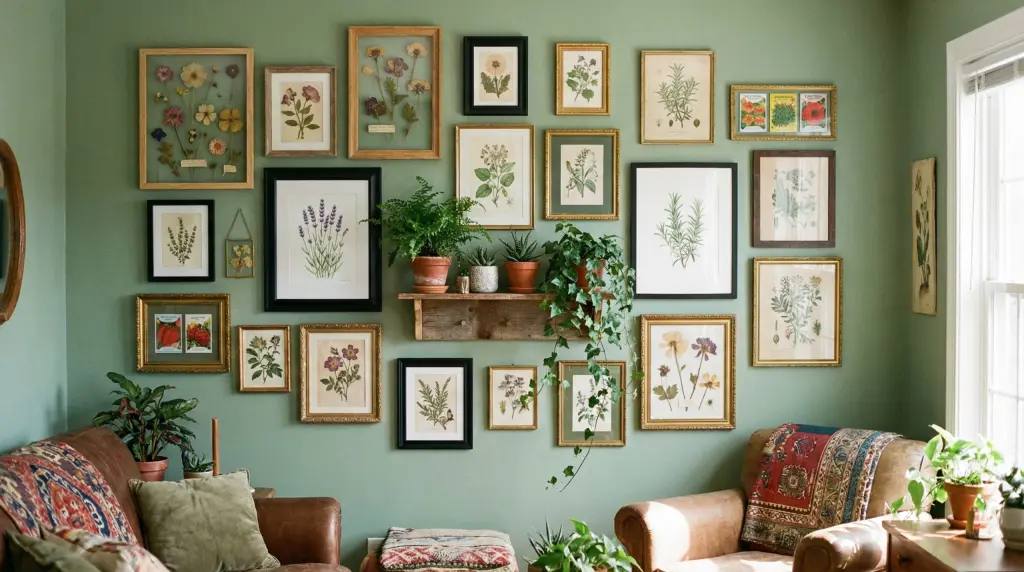
One of the best things about botanical print gallery walls is that you can build a beautiful one at almost any budget. Here’s how I think about sources across different price points.
Free: Public Domain Botanical Illustrations
Hundreds of thousands of antique botanical illustrations from the 17th, 18th, and 19th centuries are now in the public domain and available for free download in high resolution. The best sources: the Biodiversity Heritage Library (biodiversitylibrary.org), the New York Public Library Digital Collections, the Wellcome Collection, and NYPL’s plant illustration archive. Download at the highest available resolution, print at a local print shop or via an online print service, and frame them yourself. This is genuinely how some of the most beautiful botanical gallery walls I’ve seen were made — antique Ehret or Redouté engravings printed on matte paper and framed simply in black look extraordinary and cost almost nothing per print.
Affordable: Digital Download Marketplaces
Etsy and Creative Market are full of high-quality botanical print digital downloads — modern watercolor botanicals, vintage-style illustrations, minimalist line drawings, and abstract plant art. Most cost $3–15 per design, are available as instant downloads, and can be printed at home or at a print shop in whatever size you need. This gives you enormous flexibility: you can choose prints that match your color palette exactly, select sizes that work for your specific arrangement, and swap prints inexpensively if your taste changes.
Mid-Range: Art.com and Curated Online Galleries
For a more curated selection of botanical prints that arrive ready to frame — or already framed — Art.com’s botanical print collection is one of the best places to start. They carry thousands of botanical illustrations from antique engravings to contemporary photography, available in a wide range of sizes and with optional framing. The print quality is reliable, the selection is deep, and the search and filter tools make it easy to find prints that fit a specific style or color palette. Art.com is my default recommendation for anyone who wants a one-stop source for wall art across every room.
Investment: Museum Stores and Original Works
For truly special pieces — an antique original, a museum-quality reproduction, or a contemporary artist’s original botanical work — museum stores and fine art galleries are worth exploring. The Metropolitan Museum Store carries a curated selection of art prints including botanical and natural history imagery, with the quality and provenance that comes with museum sourcing. Original antique botanical prints from the 18th and 19th centuries can be found at reputable print dealers and auction houses — a genuine hand-colored copperplate engraving from a period herbal is both a piece of art history and a beautiful object that will only appreciate over time. The warm minimalism approach I wrote about in my warm minimalism guide pairs particularly well with one or two investment-grade botanical pieces as focal points.
Whatever your budget, the most important thing is to buy art that you genuinely love rather than art that you think you should own. A free public-domain print that makes you stop and look every time you walk past it is worth infinitely more than an expensive piece that just fills space.
FAQ
What size frames work best for a botanical print gallery wall?
It depends on your wall size and the layout you’re creating. For a feature wall in a living room or bedroom, a mix of 8×10, 11×14, and 16×20 inch prints gives you visual variety and allows you to create balanced arrangements. For a smaller wall or above a console table, a row of identically-sized 5×7 or 8×10 prints keeps things clean and cohesive. The most common mistake is choosing frames that are too small — art almost always looks smaller on a wall than it does in a store or on a screen. When in doubt, go up a size.
How many prints do I need for a gallery wall?
For most walls, 4–9 prints is the sweet spot. Fewer than 4 tends to look sparse rather than intentional (unless you’re using large-format prints). More than 12 can start to feel overwhelming unless the wall is very large or the prints are very small. A 6-print arrangement — two rows of three, or a loose grouping of six — is one of the most versatile and universally workable gallery wall formats.
What’s the best frame color for botanical prints?
Black and natural wood are the two most versatile frame choices for botanical prints. Black frames create a high-contrast, editorial look that works well with both black-and-white illustrations and color botanicals. Natural wood frames feel warmer and more organic, and suit watercolor botanicals and earthy color palettes particularly well. Gold or brass frames work beautifully for a more traditional, formal arrangement. The key is consistency — pick one or two finishes and stick with them.
How do I hang a gallery wall without making lots of holes in the wall?
Paper templates are your best friend: trace each frame on craft paper or newspaper, cut them out, tape them to the wall in your arrangement, and mark the nail positions before you hang anything. For a damage-free alternative, adhesive picture hanging strips (like Command strips) work well for frames up to about 16 pounds and leave no holes. They’re particularly useful in rentals, on plaster walls, or in spaces where you want flexibility to rearrange without repainting.
Can I mix botanical prints with other types of art on a gallery wall?
Absolutely. Botanical prints work well mixed with mirrors (which add light and break up the flatness of a print-only wall), maps, abstract artwork in complementary colors, or small decorative objects mounted on the wall (ceramic wall hangings, small shelves with plants). The key is maintaining a consistent frame palette and ensuring the botanical prints are prominent enough to define the overall character of the wall. If botanical prints are mixed 50/50 with unrelated art, the gallery wall may lose its sense of theme and intention.
Where can I find free printable botanical art?
The best free sources for high-resolution public domain botanical illustrations are the Biodiversity Heritage Library (biodiversitylibrary.org), the New York Public Library Digital Collections (digitalcollections.nypl.org), the Wellcome Collection (wellcomecollection.org), and the Smithsonian Libraries and Archives. All offer free high-resolution downloads of thousands of antique botanical illustrations. Download at the highest available DPI, and print at a local print shop or via an online print service for the best quality results.
A botanical print gallery wall is one of those home decorating projects that rewards patience and intentionality over speed. Take your time choosing prints you genuinely love. Lay it out on the floor before you touch the wall. Start with fewer pieces than you think you need and add gradually. The result — a wall that feels layered, personal, and alive with the beauty of the natural world — is one of the most satisfying transformations you can make to a room. And if you’re planning a room refresh that goes beyond the walls, my guide to spring tablescaping and warm minimalism have the same grounding-in-principles approach to the rest of your space.