This post may contains affiliate links. Read our full disclosure here.
If you’ve been quietly obsessed with dark, rich, atmospheric interiors — the kind that feel like a candlelit novel or a boutique hotel in Edinburgh — then moody home decor might be the design direction you’ve been circling without naming it. Moody home decor is the art of building rooms that feel deeply atmospheric, visually layered, and emotionally immersive, using a palette of deep jewel tones, near-blacks, saturated neutrals, and warm ambient light to create spaces that feel like they have a story. And yes, you can absolutely do this in a rental.
I came to moody decor the way most people do: through a single room that stopped me cold. A hotel bar in Portland, all dark walnut and hunter green velvet and the kind of lighting that makes everyone look slightly mysterious. I stood there with my Pinot Noir thinking: why does no room in my house feel like this? That was three years ago. My living room is now charcoal and forest green and I genuinely never want to leave it.
“The opposite of a bright, neutral room isn’t a dark, depressing room. It’s a room with atmosphere. That’s what moody decor actually is: interior design with emotional intelligence.”
What Is Moody Home Decor?
Moody home decor is a design approach centered on creating rooms that feel immersive, atmospheric, and emotionally resonant rather than bright, airy, and expansive. Where Scandinavian minimalism reaches for lightness and Japandi (I wrote a full guide to Japandi living room ideas here) pursues serene restraint, moody decor leans into richness: deep wall colors, layered textiles, warm amber light, and the kind of material density that makes a room feel like it was assembled over decades rather than furnished on a single IKEA run.
The palette of moody home decor centers on what designers call “saturated darks” — colors that read as deeply rich rather than simply black. Think:
- Forest and hunter green — the workhorse of the moody palette, warm enough to live with, dramatic enough to transform a room
- Deep navy and midnight blue — sophisticated and slightly melancholy in the best possible way
- Charcoal and near-black — not quite black (which can feel harsh) but dark enough to make everything else glow
- Burgundy, plum, and wine red — jewel-toned and unexpectedly livable, especially in bedrooms and dining rooms
- Deep terracotta and burnt sienna — the warmer, earthier version of moody for those who want atmosphere without going full gothic
- Aubergine and blackened violet — the most dramatic of the moody palette; use as an accent rather than an all-over wall color unless you’re committed
Crucially, moody decor is not the same as dark decor. A room can be moody in full daylight with warm wood tones and carefully layered textiles. The darkness is about emotional register, not necessarily about blocking out the sun. The defining feature of a truly moody room is not its wall color — it’s its light. Specifically, the deliberate use of warm, low, layered ambient light that makes shadows as important as illumination.
If you’ve been drawn to quiet luxury home decor or the sculptural drama of Neo Deco interior design, moody home decor is a close cousin — all three share a commitment to rooms that feel curated, elevated, and intentionally beautiful.
The Moody Living Room: Drama Without Darkness
The living room is where most people want to start with moody home decor, and it’s also where most people talk themselves out of it. The fear: it’ll feel like a cave. The reality: done right, a moody living room is the coziest, most magnetic space in the house.
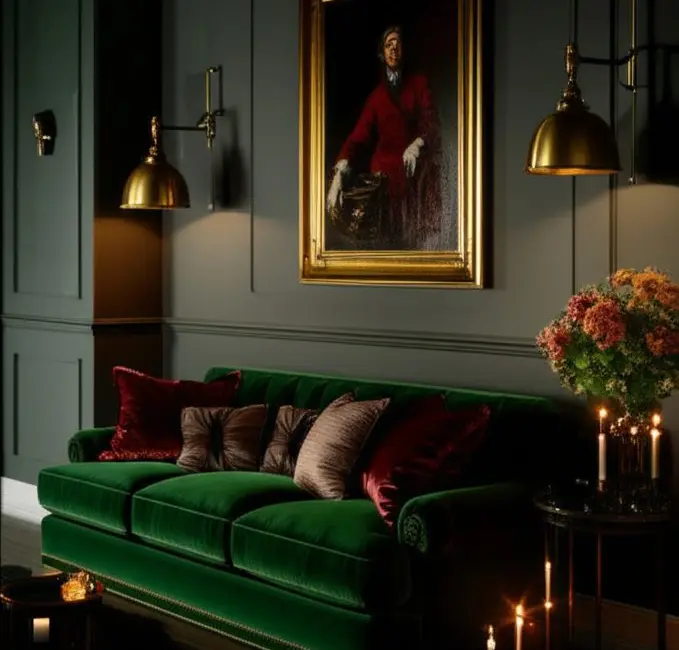
The foundation of a moody living room is the wall color, and forest green is the most forgiving starting point in the entire moody palette. It reads differently in every light — almost sage in bright afternoon sun, deeply atmospheric in the evening, and borderline magical by candlelight. My living room is painted in Farrow and Ball’s “Studio Green” and I have literally never once regretted it.
For furniture in a moody living room, the key is texture contrast. You want materials that absorb light differently:
- A velvet sofa or armchair — velvet is the quintessential moody textile because it shifts color depending on angle. Deep emerald, plum, or charcoal velvet against a dark wall creates an almost dimensional quality. Browse TOV Furniture for some genuinely beautiful velvet seating that won’t make you choose between atmosphere and quality.
- Warm metal accents in brass or antique gold — brass does something extraordinary in a moody room. It catches light and seems to glow from within. Side tables, lamp bases, picture frames, cabinet hardware — swap anything chrome or silver for warm brass alternatives and watch the room transform.
- Dark wood floors or furniture — walnut, mahogany, and dark oak all ground a moody space in the warmth it needs to avoid feeling cold or clinical.
- Layered textiles — a moody living room should have at least three textile layers: a base rug, throw pillows in mixed jewel tones, and at least one large throw or blanket draped with apparent casualness. The texture variety — velvet, boucle, linen, knit — is what makes the room feel rich rather than just dark.
Lighting in a moody living room is non-negotiable and almost entirely about going warm and low. The overhead fixture should be on a dimmer — always. Add a floor lamp with a warm bulb (2700K or lower), table lamps at seat level, and candles. Real candles if possible; LED candles if not. The goal is to have at least four light sources in the room, none of them overhead, and all of them below eye level when you’re seated.
For wall art, Art.com has an excellent dark and moody art collection that ranges from vintage botanical prints to abstract expressionism in the right palette — exactly the kind of pieces that look intentional in a moody space rather than like they’re fighting the room.
The Moody Bedroom: Sanctuary-Level Sleep Energy
If you only moodify one room in your house, make it the bedroom. A moody bedroom — deep navy walls, warm amber lamps, luxurious dark bedding, curtains that actually block the light — transforms sleep from something you do into something you experience. I am not being dramatic. The physical act of walking into a beautifully moody bedroom at the end of a long day has a measurable effect on how quickly I decompress.
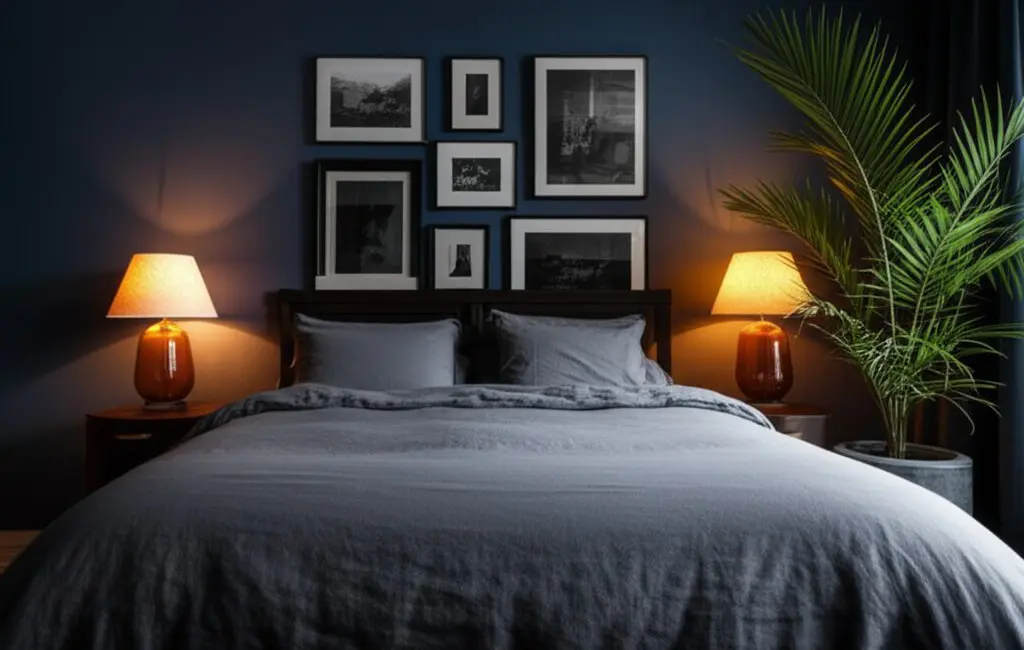
Navy blue is the bedroom’s best dark color for most people. It’s simultaneously cocooning and sophisticated — it wraps you without closing in on you the way true black or very deep charcoal can. Benjamin Moore’s “Hale Navy” and Behr’s “Midnight Blue” are both excellent paint options that read as navy in daylight and almost black by lamplight.
The bedding layer is where you have the most room to play in a moody bedroom. Dark linen is having a long and well-deserved moment — charcoal, slate gray, deep mauve, and dark sage all photograph beautifully and feel even better. Layer a lighter secondary color (dusty lilac over charcoal, warm ivory over deep slate) for the depth that makes a bed look editorial rather than simply well-made.
Dark velvet or linen blackout curtains are one of the single highest-impact investments in a moody bedroom. Floor-to-ceiling panels in a deep color that matches or complements the wall color make the ceilings look higher, the windows look grander, and the room feel like it exists in its own time zone. Add curtain rods mounted 6–12 inches above the window frame and extend them 12 inches beyond the window on each side to maximize the effect.
If you love the idea of a moody bedroom but your walls are rental-white and staying that way, the same effect is almost entirely achievable through textiles and light. Dark bedding, blackout curtain panels in a deep color, warm-toned bedside lamps with Edison or globe bulbs, and a statement headboard upholstered in velvet or boucle will carry the room further than you’d think.
The Moody Dining Room: Every Dinner Feels Like an Event
The dining room is the most forgiving space in the house for going dramatically dark, for a simple reason: you only use it for meals, which mostly happen in the evening, which is when dark rooms look their absolute best. A black or near-black dining room that feels slightly oppressive in daylight becomes cathedral-like the moment you light the candles.
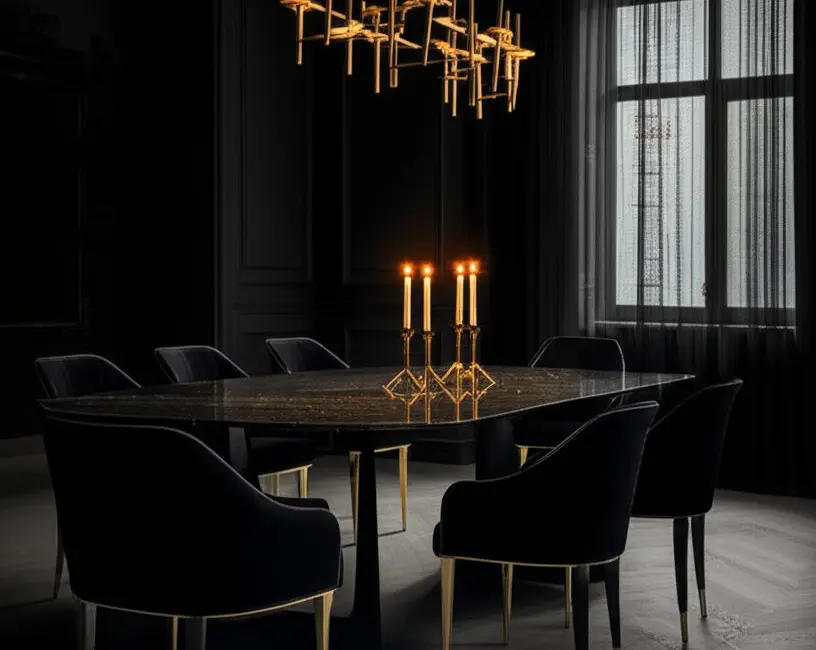
Black dining rooms are the clearest expression of moody home decor at full commitment. Not every wall needs to be black — a single black accent wall behind the dining table with the remaining walls in a deep charcoal or very dark navy achieves the same drama with less intensity. The result, when combined with the right lighting, is a room that makes every dinner feel like a private event.
For the moody dining room, the chandelier is everything. A statement pendant in aged brass, matte black, or smoked glass does double duty: it anchors the room visually and provides the warm pool of downward light that makes food, wine, and faces look their most beautiful. If you’re renting and can’t change the fixture, a dimmer switch (most are renter-installable) and a cluster of tall pillar candles on the table will get you most of the way there.
Dining chairs are one of the highest-impact and most affordable ways to introduce moody texture. Dark velvet dining chairs — even if you only change the chairs and leave everything else in place — transform a table from functional to evocative. TOV Furniture has several velvet dining chair options that work beautifully in a dark room.
For textiles on the dining table, consider dark linen napkins and a tablecloth in deep burgundy or forest green for formal evenings, and use a textured table runner in dark wool or boucle as the everyday layer. The dark floral fabric designs in the WineFullLiving Spoonflower collection include some beautiful options for custom table linens in exactly the colors a moody dining room calls for.
The Moody Home Office: Where Focus Meets Atmosphere
I resisted making my home office moody for a long time because I assumed that dark walls would make it harder to concentrate. I was completely wrong. My home office got the dark green treatment last year and it is now the room I am most productive in. There is something about an atmospheric room — something about the way low, warm light creates a kind of tunnel focus — that is genuinely conducive to deep work.
Forest green walls and a brass desk lamp is the classic moody home office combination for a reason: it looks like the library of someone who has been somewhere and knows things, and working in it has that effect on you psychologically. Pair the dark walls with warm wood furniture (walnut desk, mahogany bookcases, dark oak shelving) and a plush but not oversized area rug in a jewel tone.
For practical moody home office styling:
- A task lamp in brass or antique gold at the desk is both functional and atmospheric — the warm pool of light it casts is easier on the eyes than overhead fluorescent and looks dramatically better on video calls
- Bookshelves as backdrop — dark-spined books arranged by color or size create an organic, layered visual that photographs as sophisticated in any meeting background
- A single statement plant — a dark room with one large, healthy plant (pothos, snake plant, or fiddle leaf fig) creates the sense that the space is alive, not oppressive
- A small tray or bar cart moment near the desk with a nice glass and whatever you’re drinking while you work — it sounds silly and it is not silly at all
The moody home office is also one of the best places to invest in wall art from Art.com. A single large-format piece — an architectural print, a moody landscape, a dark botanical illustration — behind your desk elevates the entire space and is visible in every video call.
The Moody Kitchen and Bathroom: Going Dark Where It Counts
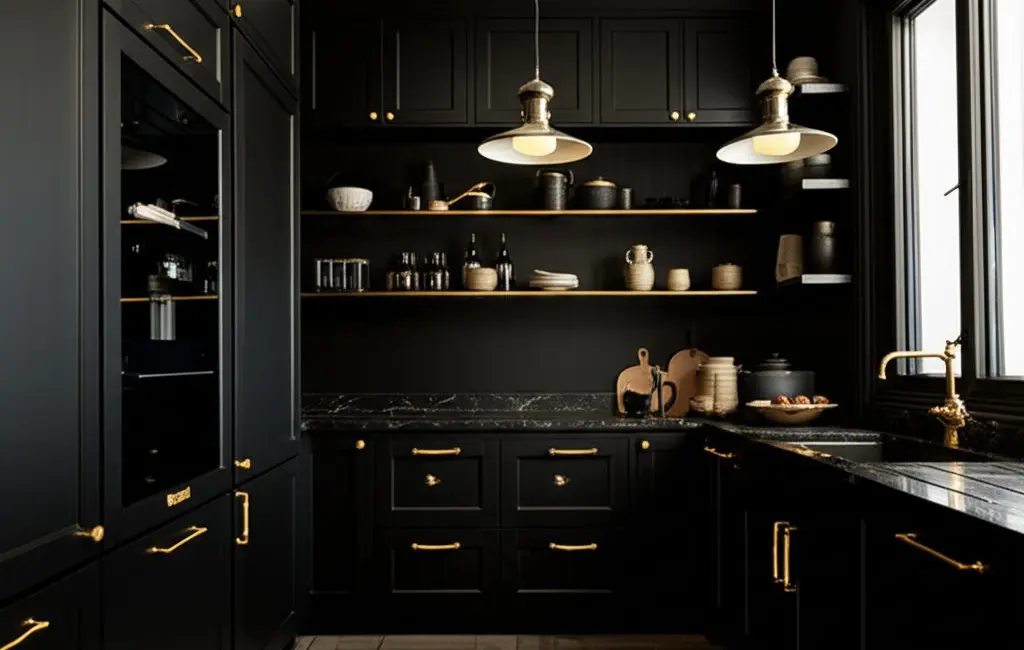
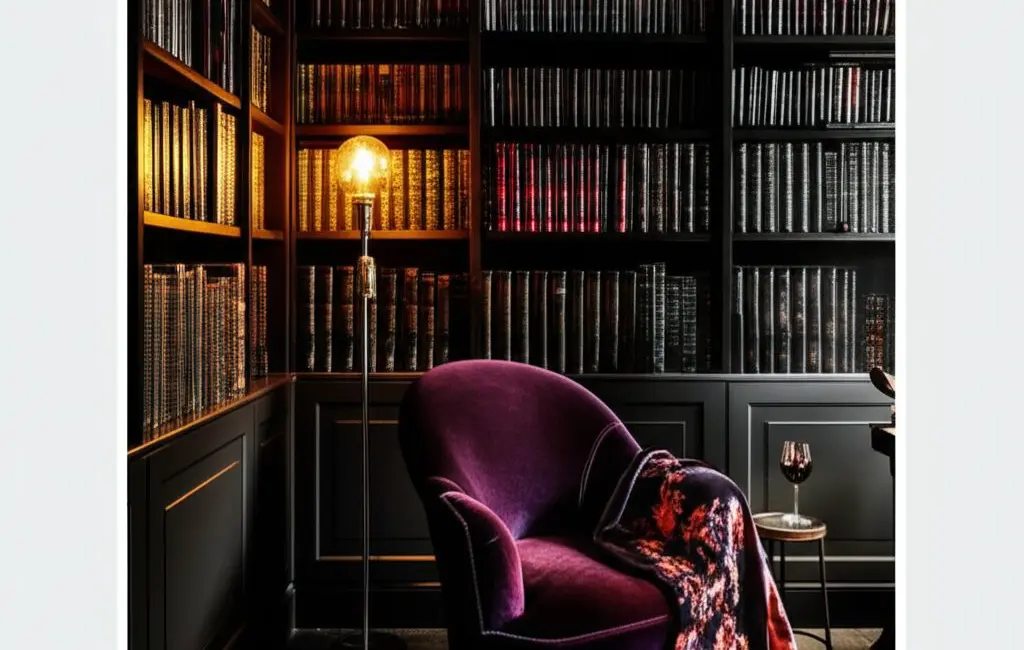
Kitchens and bathrooms are the rooms where people most hesitate to go dark, and also the rooms where the transformation is most dramatic when they do. The fear in both cases is the same: dark spaces will feel small and dark. The reality is that dark kitchens and bathrooms feel intimate, intentional, and unexpectedly luxurious.
In the moody kitchen, black or very dark navy cabinetry is the central decision. Black cabinets read dramatically in photographs but live surprisingly well day-to-day — they don’t show dust, they create a neutral backdrop for colorful ceramics and food, and they provide the high-contrast background that makes brass hardware (and the contents of your open shelves) look deliberately curated. The key to keeping a dark kitchen from feeling oppressive is under-cabinet lighting — warm LED strip lights mounted under upper cabinets flood the countertop with working light and create a beautiful ambient glow when the overhead lights are dimmed.
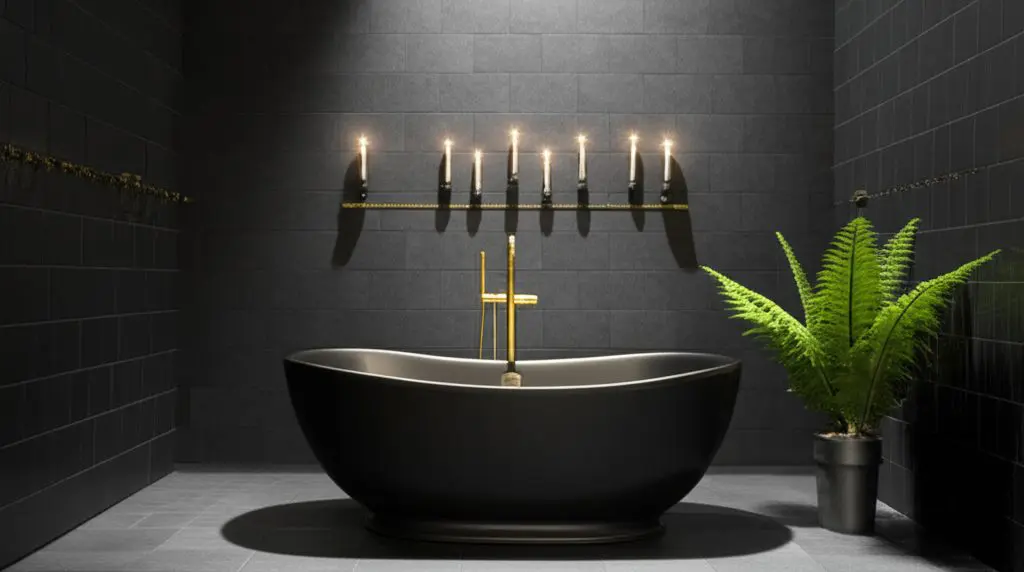
For the moody bathroom, the transformation is even more dramatic relative to the investment. Dark tile on a single wall — even peel-and-stick tile in a deep charcoal or slate — creates an accent effect that reads as intentional design. A black or matte charcoal vanity (easily achieved with cabinet paint) against lighter tile creates exactly the kind of contrast that photographs as a spa-level bathroom. Add a large round mirror in brass or matte black, swap the light fixture for one with warm-toned Edison bulbs, and the transformation is complete.
Candles in the bathroom are not a cliché — they are the single cheapest, highest-impact intervention in a moody bathroom. A cluster of three to five pillar candles in varying heights on a tray near the tub (battery-operated if necessary) creates exactly the kind of atmospheric lighting that makes a 20-minute bath feel restorative in a way that overhead lighting simply cannot.
How to Start Your Moody Transformation Without Repainting Everything
The most common question I get about moody home decor is: where do I even start? The answer, almost always, is textiles and light — not paint. Paint is the highest-commitment moody intervention. Textiles and light are reversible, renter-friendly, and have a surprisingly high percentage of the impact.
Here’s the sequence I recommend for anyone starting a moody transformation:
- Step 1: Change the light — swap every overhead bright white bulb for warm amber (2700K or lower), add at least two floor or table lamps with warm-toned shades, and buy a dimmer switch for your most-used room. This single change will shift the mood of the space more than any paint color.
- Step 2: Add dark textiles — dark velvet or linen throw pillows, a dark throw blanket, and if possible a dark velvet accent chair or sofa throw. These are all reversible and they anchor the palette.
- Step 3: Add a dark statement piece — a dark-painted side table, a dark-framed gallery wall from Art.com, or a single piece of statement furniture in a jewel tone. This gives the room its focal point.
- Step 4: Add living texture — a large plant, a stack of dark-spined books, a tray of candles. These organic elements are what make a moody room feel curated rather than decorated.
- Step 5: Paint one wall — if you get to step 4 and you want more, paint one wall. The accent wall approach lets you test a color at full depth before committing to the whole room. In most rooms, one deeply colored accent wall is more impactful than four lighter ones.
- Step 6: Add custom textiles — for the most personalized moody rooms, custom fabric and wallpaper from the WineFullLiving Spoonflower collection lets you bring dark botanical, dark floral, and moody pattern designs into your specific space.
The truth about moody home decor is that it requires more curation but less money than most people assume. The look is built more on restraint and layering than on expensive individual pieces. A $25 dark throw pillow on a light sofa does more for a room’s atmosphere than a $500 bright accent piece. This is the style that rewards patience and a good eye far more than budget.
If you’re drawn to the moody aesthetic, you might also love the calm sophistication of sage green living room ideas — a lighter entry point into the saturated-color world — or the sculptural restraint of Japandi living room design. For moody rooms with a more elevated editorial feel, the quiet luxury decor guide covers many of the same design principles with slightly more restraint. And if you’re building a moody home bar or entertaining corner, the home wine bar setup guide and the bar cart styling guide are both written with exactly this aesthetic in mind. For the desk and shelving layer of a moody home office, the home office decor guide goes deep on arrangement and styling.
Frequently Asked Questions About Moody Home Decor
Will moody home decor make a small room feel smaller?
Not necessarily — and sometimes the opposite is true. Dark colors in a small room with good warm lighting and mirrors can feel cocooning rather than cramped, and the visual contrast between dark walls and lighter furnishings can make individual pieces appear to float, which paradoxically creates a sense of visual space. The key variables are lighting and ceiling color. Keep ceilings lighter than the walls (white or very light gray) and layer multiple warm light sources to prevent the room from feeling oppressive.
What are the best moody home decor wall colors for beginners?
Forest green is the most forgiving starting point — it reads warm in low light, works with almost every wood tone, and is flattering to human skin in a way that cool dark colors (true black, dark gray) are not. Deep navy is the second most accessible, followed by dark terracotta for those who want warmth without going dark. True black is the most dramatic and the hardest to live with; reserve it for accent walls, cabinetry, or rooms you use primarily at night.
Can I do moody home decor in a rental?
Absolutely. The core elements of moody decor — warm amber lighting, dark textiles, velvet furniture, layered throw pillows, dark curtains, brass accents, statement plants, and dark-framed art — are all entirely reversible and renter-friendly. You can achieve 70% of the moody look without touching a single wall. Peel-and-stick wallpaper in a dark pattern is another renter-friendly option for accent walls. Save the paint commitment for when you own your space.
What wine goes best with a moody home decor evening?
I mean, obviously I had to include this. For a moody living room evening, you want something that matches the register: Pinot Noir for the forest-green-and-velvet vibe, a full-bodied Grenache or Rhone blend for the burgundy-and-brass room, or a smoky Syrah for the truly dramatic all-black setup. If you want a white that fits the moody aesthetic, a rich, barrel-aged Chardonnay or an orange wine has enough texture and depth to work. Rosé is… a different energy. Respect it, but it goes better in the bright kitchen.
Sources and further reading: Farrow and Ball color library (farrow-ball.com); Benjamin Moore Designer Picks 2026; Architectural Digest “The Dark Room Revival” January 2026; Pinterest 100 Trends Report 2026 (moody interiors ranked #7 in home); Elle Decor “Why We’re All Going Dark” March 2026.