This post may contains affiliate links. Read our full disclosure here.
Coffee table styling ideas are everywhere — on Pinterest, in every design magazine, across every home decor account you follow. But here is the honest truth: most of them look impossibly curated, and when you try to recreate them at home, the result somehow looks either cluttered or sterile. I spent a long time feeling that way about my own coffee table before I finally understood that the problem was not my taste or my budget. It was that I was treating coffee table styling like decoration, when it is actually more like composition. The moment I started thinking about my coffee table the way a visual artist thinks about a canvas — with intention about scale, height, texture, and negative space — everything clicked. These are the coffee table styling ideas that actually work in real homes, not just in photo shoots.
Whether you have a round marble table, a rectangular dark wood piece, a simple ikea hack, or a small square that serves a tiny apartment living room, the principles here apply. I will cover the foundational rule that ties everything together, how to use trays properly, the right way to work with coffee table books (they are so much more versatile than most people realize), how to build a vignette with height and texture, seasonal styling approaches, and specific tips for coffee table styling ideas for small living rooms where every inch counts.
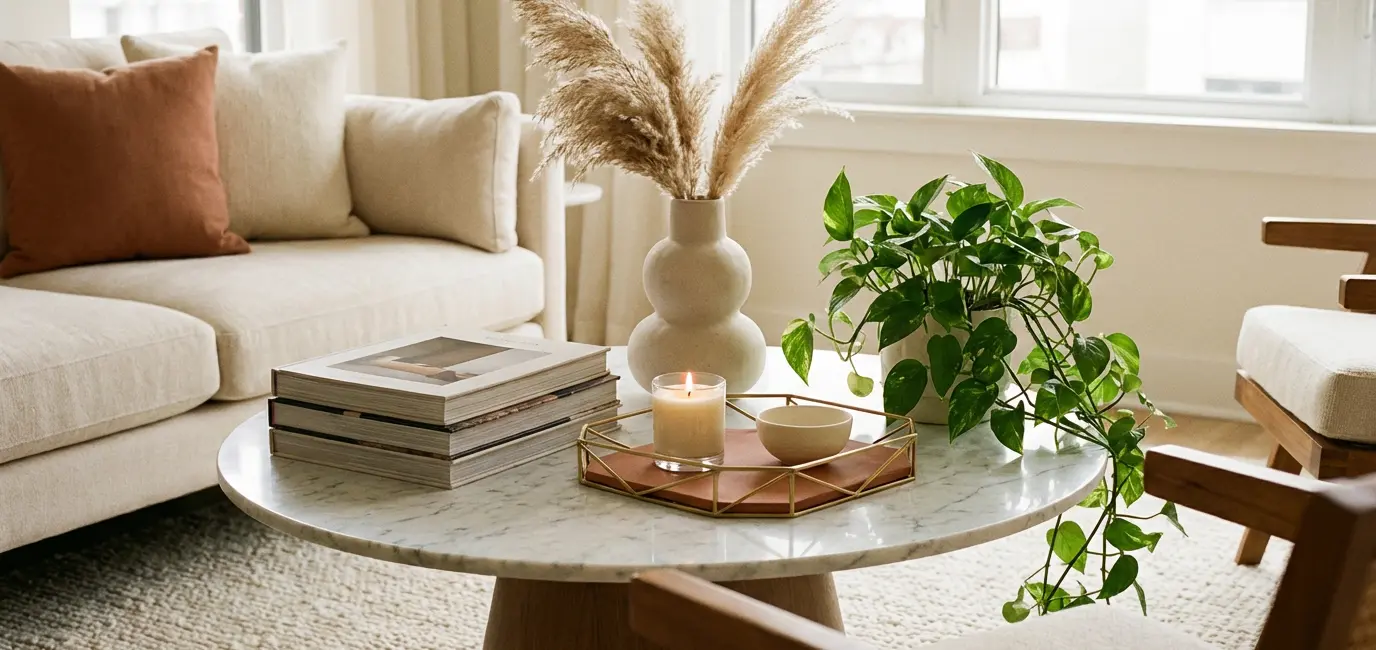
The One Rule That Makes Every Coffee Table Look Intentional
Every great coffee table styling idea I have ever tried or seen comes back to a single underlying principle: odd numbers and varied heights. This sounds almost absurdly simple, but it is genuinely the load-bearing rule of all table styling. Group objects in sets of three or five, never two or four. Within each grouping, vary the heights dramatically — something tall, something medium, something low. The human eye reads odd-numbered groupings as organic and intentional. Even-numbered groupings read as staged and stiff, no matter how beautiful the individual pieces are.
The classic three-object grouping for a coffee table styling arrangement looks like this: a tall element (a candle on a candlestick, a bud vase with a branch, a tall sculptural object), a medium element (a stack of books, a small succulent in a pot, a low bowl filled with something textural), and a low flat element (a tray, a wide shallow dish, a collection of river stones spread across the surface). Your eye travels up, across, and down. The composition feels complete. That is the whole structure. Once you understand it, you can execute coffee table styling ideas in five minutes with whatever you already have.
The second component of this rule is negative space. Do not cover your entire coffee table surface. Leave at least one-third of the surface empty. That empty space is not wasted — it is what makes the styled portion feel considered rather than chaotic. It also, practically, leaves room for a glass of wine, a book you are reading, or a remote control without immediately destroying the arrangement. Good coffee table styling lives in harmony with how you actually use the table.
“A great coffee table arrangement is like a great dinner party guest list: it is not about filling every seat. It is about the right people, with enough space between them to actually have a conversation.”
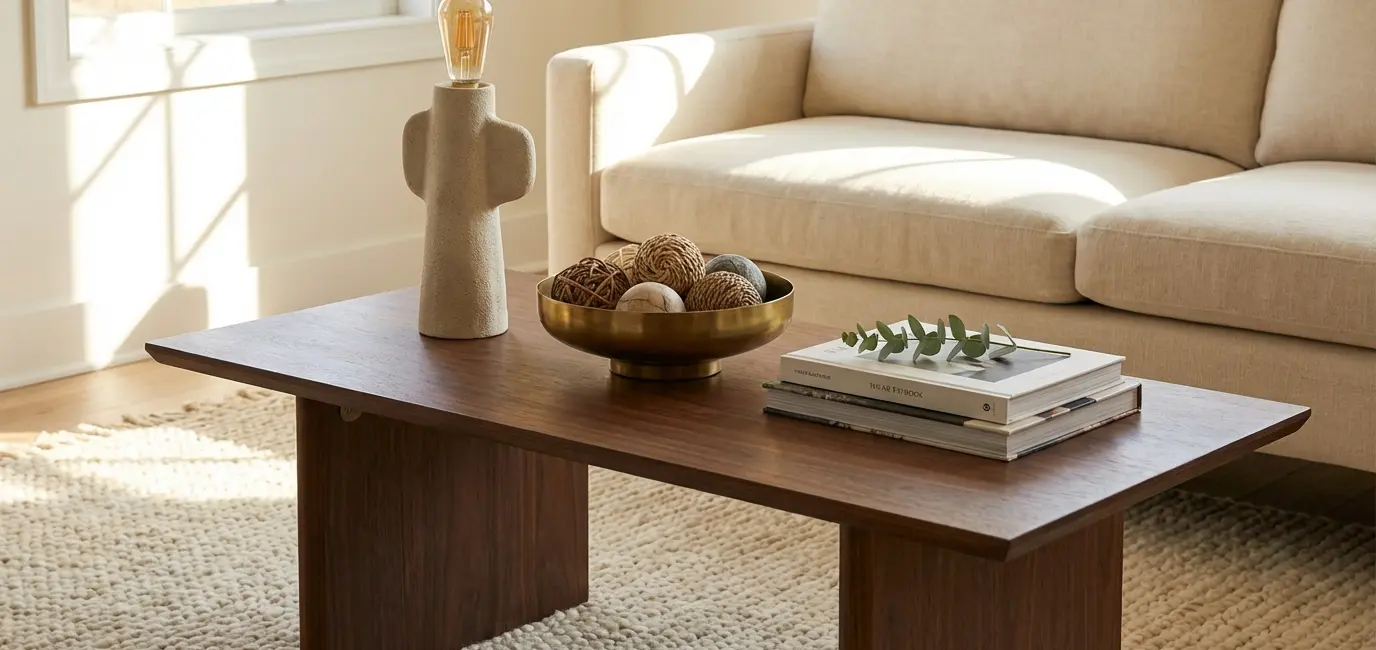
The Tray: Your Coffee Table’s Best Friend
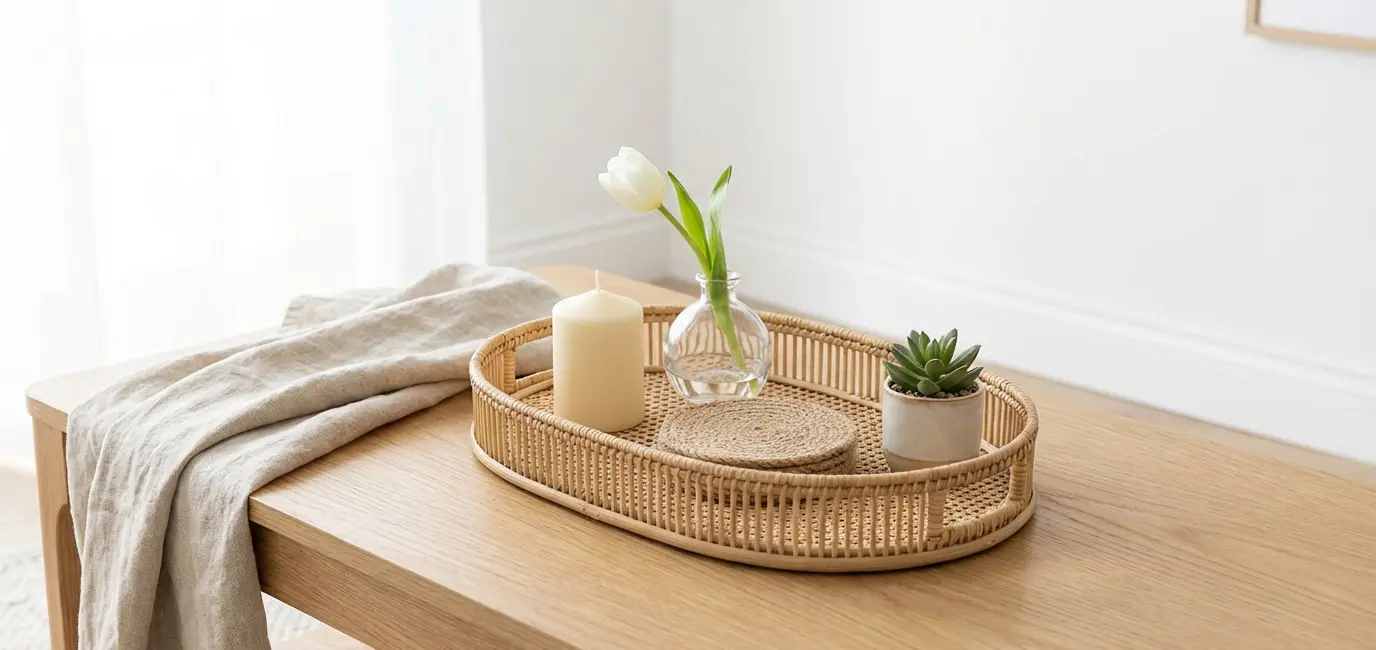
If I had to pick one single piece of advice from all my coffee table styling ideas, it would be this: use a tray. A tray does three things that nothing else does as elegantly. First, it contains visual chaos — a group of five small objects sitting loose on a table looks like clutter, but the exact same five objects placed inside a tray looks styled. The tray creates a visual boundary that tells the eye “this is intentional.” Second, it makes rearranging or clearing the table effortless — you can pick up the entire arrangement in one move when you need to use the table surface. Third, it introduces a material that adds texture and warmth to your coffee table styling scheme even before you put anything inside it.
The best trays for coffee table styling ideas have some visual weight of their own. Rattan and wicker trays add a natural, earthy texture that works in every style from bohemian to coastal to warm minimalism. Lacquered trays in black, white, or a deep jewel tone (navy, forest green, burgundy) add a layer of sophistication and color. Brass or gold metal trays catch light beautifully and anchor a more glam or maximalist arrangement. Marble or stone trays are heavier but add a genuinely luxurious quality to the surface.
What goes inside the tray? Keep it simple: one candle (taper or pillar or the short squat kind that pools dramatically), one small plant or vase with a single stem, one coaster or small dish for a ring or remote, and one small sculptural object. That is it. The tray sets the boundary; the objects inside it do the curating. You can find a beautiful decorative tray for coffee table styling across a wide range of materials and price points — rattan versions are typically the most affordable and the most versatile in terms of style compatibility.
Coffee Table Books: Decor, Not Clutter
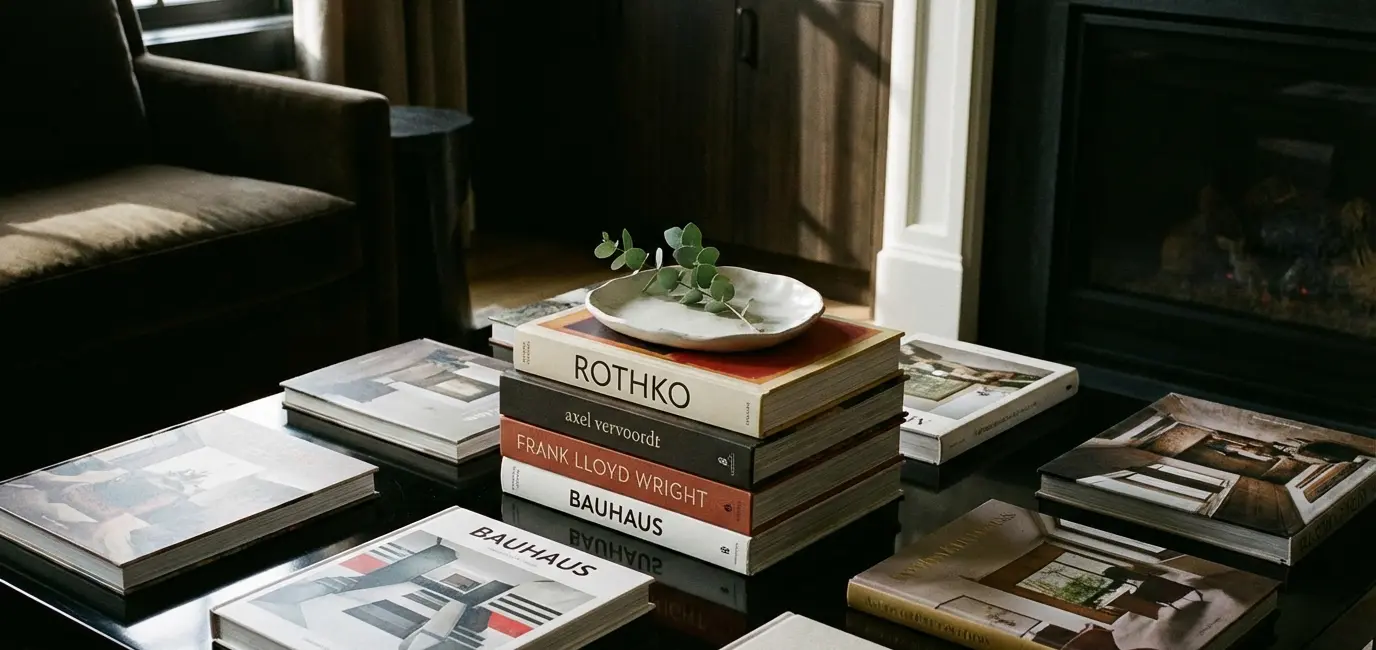
Coffee table books are one of the most misunderstood elements in coffee table styling ideas. Most people treat them as a single decorative element — one or two books stacked neatly together. But the real design versatility of coffee table books is that they function as architecture for your arrangement. A stack of three or four oversized books creates a riser that elevates whatever sits on top of it. A single large book laid flat and slightly angled acts as a platform for a smaller vignette. Books spread at different angles across the table surface make the entire surface feel curated without any additional objects.
For coffee table styling purposes, the ideal coffee table book is large (at least 10 inches wide), visually interesting on the cover (art, photography, architecture, fashion, nature — anything with a strong image or typographic cover), and personally meaningful to you. The worst coffee table styling idea I see repeatedly is the generic stack of books bought purely for their spine color to match a decor palette, with no connection to the person who lives in the space. Your books should tell a story about you. They are a conversation starter, a reflection of your interests, and a way to make your coffee table styling feel personal rather than Pinterest-perfect.
A stack of books becomes the most versatile element in your arrangement when you use it as a riser: place the stack at one end of the tray or at one anchor point in your arrangement, then set a small ceramic dish, a wax sculpture, or a single candle on top. The height differential between the book stack and the flat surface objects creates the visual interest that makes coffee table styling ideas photograph beautifully and look effortlessly curated in person. For specific art book recommendations that work beautifully as coffee table styling risers, architecture and interior design books are consistently the most versatile in terms of size, color, and visual weight.
Height, Texture, and the Art of the Vignette
A vignette is a small, self-contained scene — a term from interior design that simply means a curated grouping of objects that tells a coherent visual story. Every great coffee table styling idea is really a vignette, and the key ingredients of a successful vignette are height variation, texture contrast, and material mix.
Height variation is what I already covered in the odd-numbers rule: tall, medium, low. But within each height category, think about what that height is doing for the eye’s movement across the arrangement. A tall candle on the left and a medium vase on the right creates a gentle descending line that feels elegant. An arrangement where everything is the same height creates a flat, uninteresting shelf-display effect. The goal is movement — you want the eye to travel.
Texture contrast is the underrated element in most coffee table styling ideas. Smooth marble next to rough woven rattan. A glossy lacquer tray alongside a matte ceramic vase. Soft linen napkin folded near a hard glass object. The more texture contrast you introduce, the more tactilely rich and visually interesting the arrangement becomes — and texture contrast is essentially free, because it comes from the surfaces of objects you likely already own.
Material mix follows a similar logic: aim for three to four different materials in a single vignette. Natural (wood, stone, ceramic, dried botanicals), metallic (brass, gold, silver), organic (plants, fresh or dried), and man-made (glass, lacquer, linen). That four-material mix creates depth and the sense that the arrangement evolved organically rather than being assembled all at once. For pieces that add beautiful material contrast to your coffee table styling, the Art.com collection has sculptural decorative objects and art objects that work particularly well as the “talent” piece in a vignette — the singular interesting item that everything else arranges itself around.
Seasonal Coffee Table Styling That Actually Works
One of the easiest ways to keep your home feeling fresh year-round is to change your coffee table styling with the seasons. You do not need to buy all new objects — you need to swap two or three seasonal elements while keeping your permanent base pieces in place. Your tray, your book stack, and one or two anchor objects stay. What changes is the botanical element, the candle scent and color, and one textural piece that signals the time of year.
Spring Coffee Table Styling
For spring coffee table styling ideas, the seasonal swap is simple: replace any dark or heavy winter botanicals (dried eucalyptus, pinecones, dark berry stems) with light, fresh elements. A small pot of blooming hyacinth, a few stems of ranunculus in a bud vase, or a low bowl of smooth pale stones collected on a spring walk. Swap the heavy winter candle (cedar, sandalwood, woodsmoke) for something airy — jasmine, white tea, fresh linen. Add one pastel accent: a pale lavender or soft sage green coaster, a blush ceramic dish. The overall effect should feel like opening a window. The spring home refresh 2026 guide has a full framework for translating this kind of seasonal lightness across your entire home, not just the coffee table.
Summer Coffee Table Styling
Summer coffee table styling leans into texture and lightness. Replace any soft textiles with crisp, geometric objects. A collection of shells or coral-colored ceramic pieces in a shallow bowl. A tall slender vase with a single tropical stem or a branch of olive leaves. A small glass terrarium with air plants. Summer is the season to maximize natural materials and introduce blues and greens into the palette. This is also the season to let your coffee table styling feel genuinely simple — summer is not the time for a heavily layered vignette. Two or three beautifully chosen objects in a well-proportioned tray is the summer ideal.
Fall and Winter Coffee Table Styling
Fall and winter are the richest seasons for coffee table styling ideas because the whole design language shifts toward depth, warmth, and layering. In fall: a grouping of gourds and dried seed pods alongside amber and rust-toned candles. A stack of books with autumn photography covers. A small lantern with a pillar candle. In winter: white taper candles in silver candlesticks, a bowl of mercury glass ornaments, branches of dried cotton stems in a vase. The best scented candles guide is the place to start for the right winter candle picks — fragrance is the fourth dimension of a seasonal coffee table styling vignette that photographs cannot convey but fills a room completely.
Coffee Table Styling for Small Living Rooms
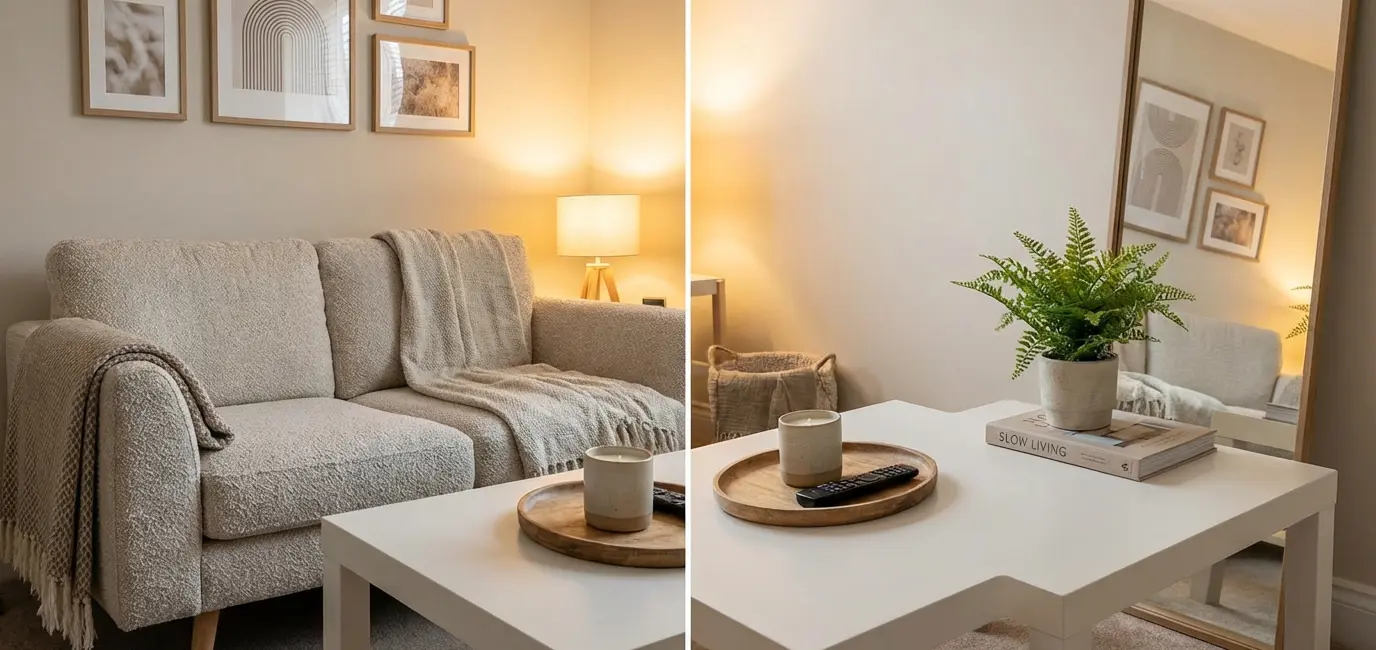
Small living rooms require a different approach to coffee table styling ideas than open, spacious rooms. The principles are the same, but the application is stricter. In a small room, visual clutter on the coffee table makes the entire room feel smaller and more chaotic. The antidote is not to leave the table empty — an empty coffee table in a small room just looks like you forgot to decorate it. The antidote is precision: fewer objects, better objects, more intentional negative space.
The small living room decorating ideas guide covers this in detail, but the core rule for coffee table styling in a small living room is: maximum three objects, one of which must be functional (a tray, a book you are actually reading, a remote-holder). This keeps the table from competing visually with everything else happening in the room while still looking intentionally decorated rather than bare.
Scale matters enormously in small-room coffee table styling. A small table calls for proportionally smaller objects — a mini tray rather than a full-size one, a bud vase with a single stem rather than a large arrangement, a stack of two books rather than four. Oversized objects on a small coffee table look like a mistake; correctly scaled objects look precise and sophisticated. The goal in a small room is always to make the space feel larger, not just prettier — and restraint in coffee table styling ideas is one of the most powerful tools you have.
One technique I love for small-room coffee table styling: use a round tray on a square table, or a square tray on a round table. The contrast in shape creates visual interest that does not require adding more objects. The tray itself becomes the decor, with one or two very spare objects inside. This approach also maximizes usable surface area, which matters when you are working with a compact footprint. For a beautiful, proportionally appropriate tray option, small rattan trays consistently deliver the best combination of visual warmth, appropriate scale, and price accessibility.
If you are working on a broader living room transformation alongside your coffee table styling ideas, the small living room decorating ideas guide covers the full room with the same principles-over-products approach. The warm minimalism interior design 2026 trend guide explains the dominant aesthetic that is shaping living room styling right now — and it aligns perfectly with the vignette-based approach I have described here. For the spaces around your coffee table, the spring entryway decor ideas and the spring mantel decorating guide apply the same principles to other high-visibility surfaces in your home. And if entertaining is part of why you want your living room looking its best, the spring tablescaping ideas 2026 guide has the table counterpart to everything here — same rules, dining context.
Frequently Asked Questions
What should I put on a coffee table for styling?
The best coffee table styling ideas use three to five objects in odd-numbered groupings with varied heights. The core elements are: a tray to create visual containment, a stack of two to three coffee table books as a riser, one tall element (candle, vase, sculptural object), one medium element (plant, bowl with objects), and one low flat element. Leave at least one-third of the surface empty as negative space.
How do I style a coffee table without it looking cluttered?
The key to coffee table styling without clutter is the tray. Place all small objects inside a tray rather than loose on the surface. Limit yourself to five objects maximum including the tray itself. Leave significant negative space. For small living rooms, reduce to three objects total.
What is the rule of three in coffee table styling?
The rule of three in coffee table styling means grouping objects in sets of three rather than two or four. The human eye reads three-object groupings as organic and intentional. Within the group of three, vary the heights significantly — tall, medium, and low — to create visual movement.
What are good coffee table books for styling?
The best coffee table books for styling are large-format (at least 10 inches wide), visually striking on the cover, and personally meaningful to you. Art books, architecture books, nature photography books, and fashion retrospectives all work well. Use a stack of three as a riser to create height variation in your arrangement.
How do I style a small coffee table?
For small coffee table styling ideas, use a maximum of three objects, keep at least one functional (a tray, a coaster set, a book you are reading), and choose proportionally smaller accessories. A small rattan tray with one candle and one small plant is the classic small-table formula. Use shape contrast — a round tray on a square table — to create visual interest without adding more objects.
How often should I change my coffee table styling?
Changing your coffee table styling seasonally — four times a year — is the most practical cadence. Keep three to four permanent anchor pieces (your tray, books, primary sculptural object) and swap the botanical element, the candle, and one accent piece with each season. This keeps your living room feeling fresh without requiring a full redecoration each time.
The best coffee table styling ideas are always the ones you will actually maintain. Start with one principle from this guide — the tray, the rule of three, or the height variation — and build from there. A coffee table that looks like you does not need to be perfect. It needs to feel intentional.