This post may contains affiliate links. Read our full disclosure here.
The best book club wine pairings match the genre, mood, and setting of the book your group is reading: a brooding Pinot Noir for a psychological thriller, a crisp Sauvignon Blanc for a literary novel, a jubilant Prosecco for a beach read, and a warm, spiced Syrah for historical fiction. Getting the wine right transforms a good book club meeting into a great one — and I say this as someone who has hosted dozens of them. The right bottle in hand does not just complement the book; it puts everyone in the exact emotional register the author intended. Here is the complete genre-by-genre guide to book club wine pairings, plus everything you need to host a night worth showing up for.
Why Book Club Wine Pairings Are Worth Getting Right
Most book clubs default to “everyone brings a bottle of something” and call it wine pairing. And there is nothing wrong with that approach — a relaxed, everyone-contributes format is part of what makes book club feel like a party rather than homework. But intentional book club wine pairings add a layer of experience that elevates the entire evening in ways that are surprisingly easy to achieve.
Think about it from the perspective of atmosphere. A thriller set in the rain-soaked streets of 1940s Paris calls for a different sensory accompaniment than a sun-drenched Tuscan romance. A memoir about grief and resilience deserves something more considered than a random Cab from the grocery store shelf. When the wine matches the emotional world of the book, it acts as a kind of ambient soundtrack — not competing with the story, but deepening it.
“The right wine for book club is not the most impressive bottle. It is the one that makes the book feel more real, more present, more alive in the room.”
There is also a purely practical reason to think about book club wine pairings intentionally: it gives the host a framework that removes decision fatigue. Instead of staring at forty bottles and picking randomly, you have a starting point — “we are reading a moody Scottish historical novel, so I am looking for something with earthy depth” — and that constraint makes the choice faster and usually better. This guide gives you exactly that framework, genre by genre.
Book Club Wine Pairings by Genre: The Complete Guide
These are the book club wine pairings I have developed and tested over years of hosting and attending book clubs. Each is matched to the genre’s dominant emotional register and pacing, not just the setting — because the feeling of a book matters more to the pairing than its geography.
Thriller and Mystery
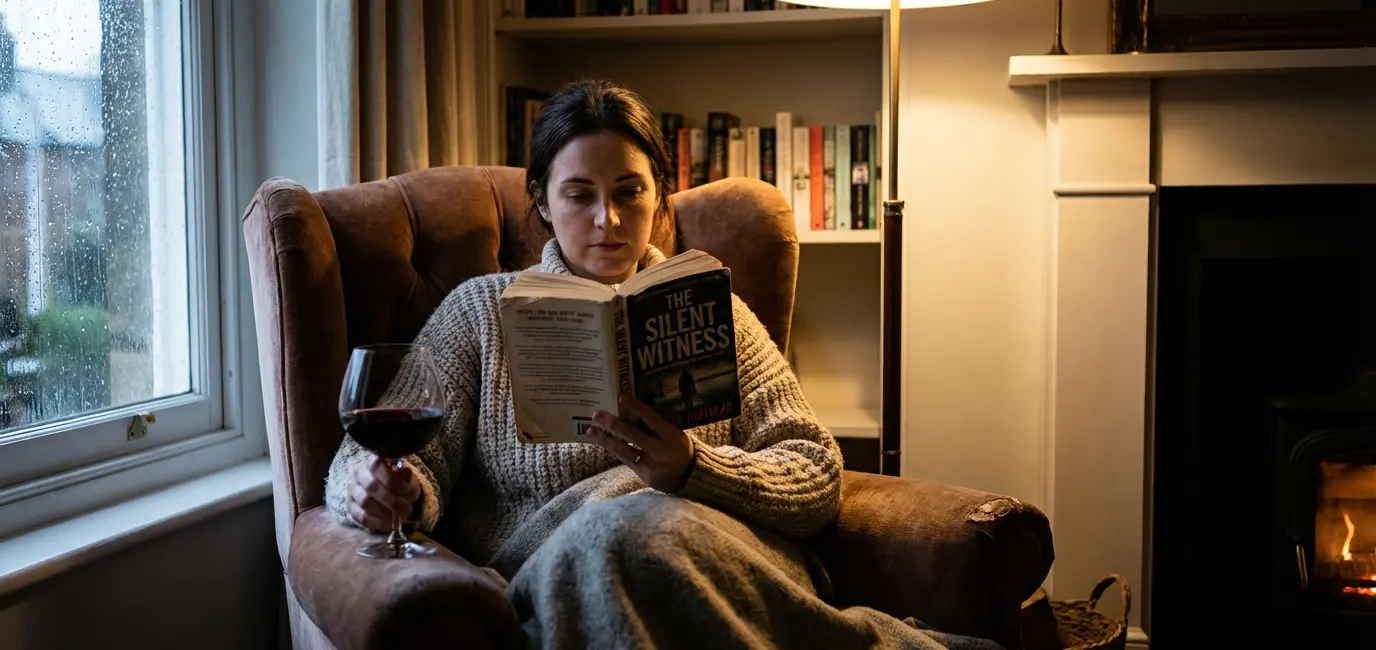
Best wine: Pinot Noir, Malbec, or an aged Bordeaux. Thrillers and mysteries share a specific quality: they are propulsive, slightly dark, and intensely immersive. The book club wine pairing here should match that energy without overwhelming it. Pinot Noir is my first recommendation — it is complex, earthy, and slightly unpredictable in a way that echoes the best thriller writing. An aged Bordeaux, with its layers of tannin and slow revelation of flavor, is perfect for a slower-burn psychological thriller. Malbec is the straightforward choice when you want something bold and satisfying without too much fuss: for Gillian Flynn nights, Tana French marathons, and anything by Lisa Gardner. Browse the full red wine selection on Wine.com for all three.
Specific book pairings: Gone Girl by Gillian Flynn → Malbec (bold, disturbing, impossible to put down). In the Woods by Tana French → Burgundy Pinot Noir (moody, Irish, full of buried secrets). The Girl with the Dragon Tattoo by Stieg Larsson → an aged Bordeaux or a dark Rhone blend (Scandinavian winter energy, slow and relentless).
Romance
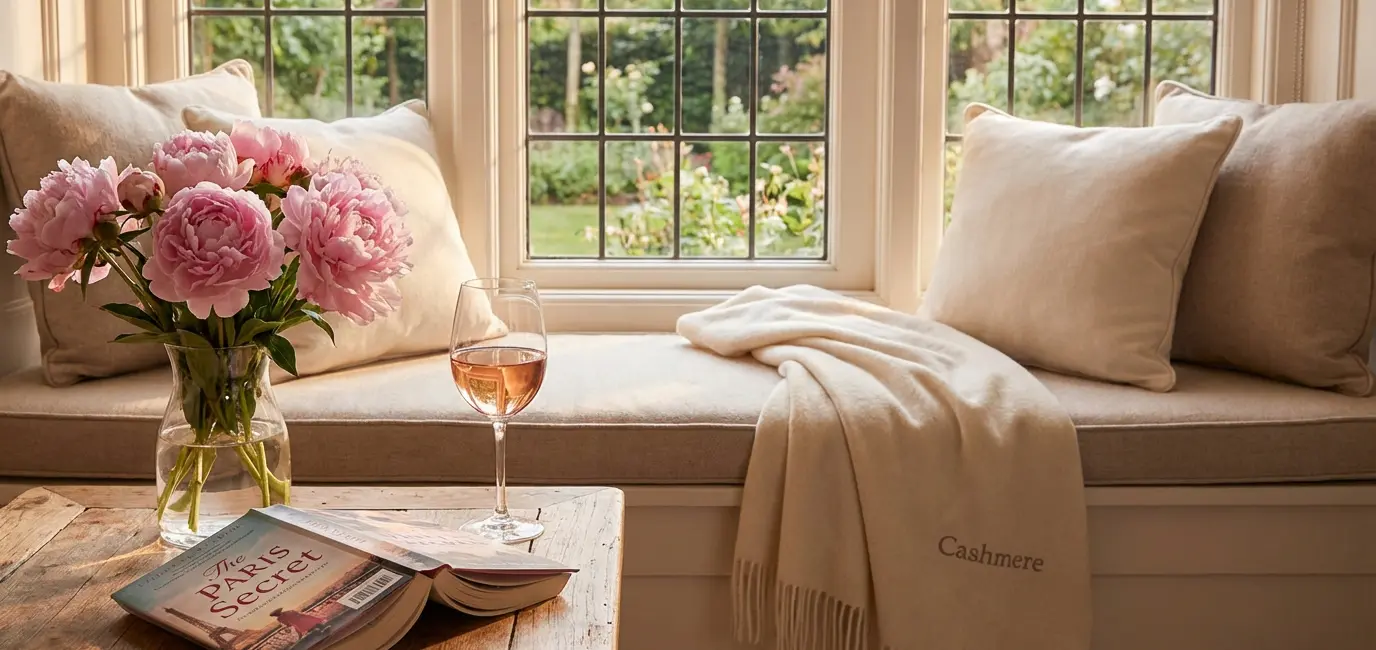
Best wine: Rosé of Provence, Moscato d’Asti, or a Cava brut. Romance novels — whether contemporary, historical, or the increasingly popular romantasy genre — share an emotional warmth and an optimistic forward momentum that calls for wines in the same register. Provence rosé is the quintessential romance reading wine: pale, beautiful, dry but with enough fruit to feel celebratory. For sweeter, lighter romances (Emily Henry, Talia Hibbert), a lightly sparkling Moscato d’Asti adds a playful effervescence that matches the energy perfectly. For historical romance (Julia Quinn, Georgette Heyer), a Cava brut or English sparkling wine brings in an appropriate old-world elegance. Our guide to the best rosé wines for spring 2026 covers the full region-by-region breakdown for finding your ideal rosé pairing.
Specific book pairings: Beach Read by Emily Henry → Provence rosé (light, summery, effortlessly charming). Outlander by Diana Gabaldon → Scotch whisky-adjacent, or a full-bodied Syrah for a more Scottish feel (save the wine for the Jamie scenes). The Bridgertons by Julia Quinn → English sparkling wine or a delicate Champagne (Regency-era elegance, obviously).
Literary Fiction
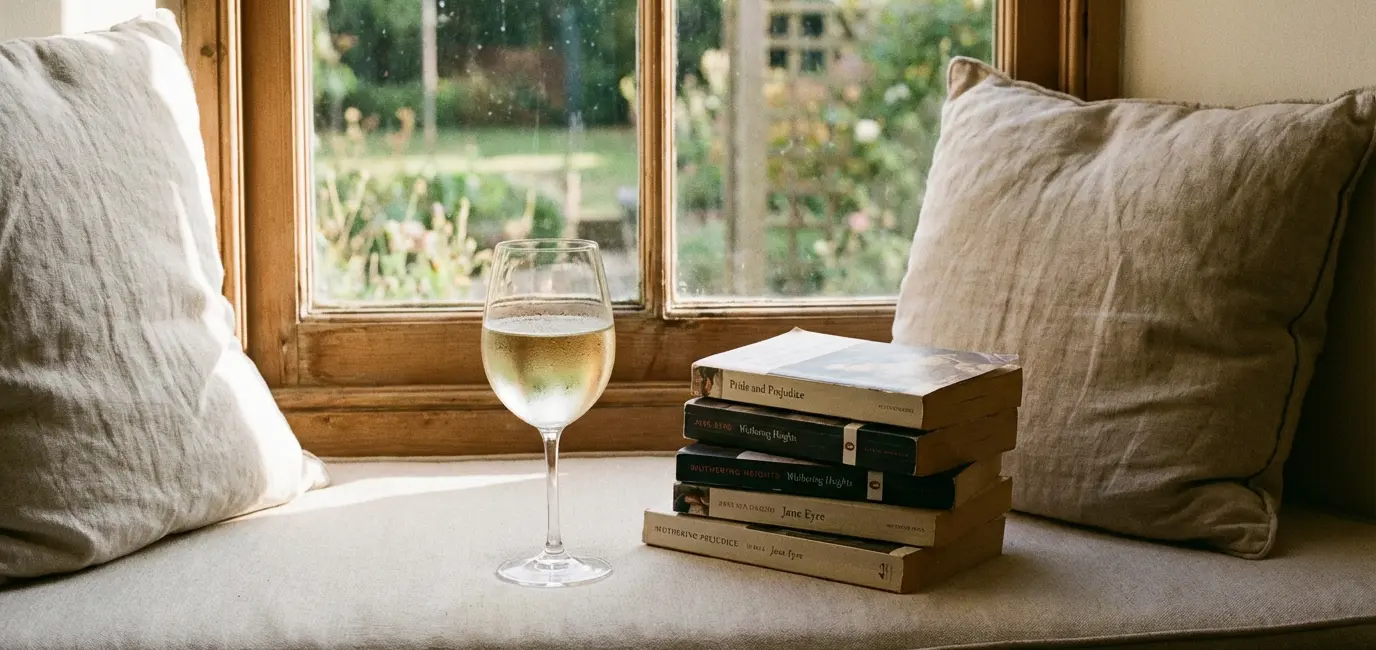
Best wine: Chardonnay, White Burgundy, or a Grüner Veltliner. Literary fiction operates at a higher register of intentionality than most genres — the prose is more considered, the pacing more deliberate, the emotional stakes more interior. The book club wine pairing should match: a wine with depth and subtlety that does not demand attention but rewards it when you pay some. White Burgundy is the obvious premium choice — layered, mineral, endlessly complex. A Grüner Veltliner for something a little more interesting and less expected. A quality oaked Chardonnay for when you want the richness without the Burgundy price tag. Explore white wines on Wine.com for the full range of options.
Specific book pairings: Normal People by Sally Rooney → an unshowy Chardonnay or a light natural wine (understated, Irish, quietly devastating). Pachinko by Min Jin Lee → a Junmai Daiginjo sake if you want to go fully thematic, or a mineral Chablis (restrained, precise, deeply moving). Lincoln in the Bardo by George Saunders → an orange wine or an aged Riesling (strange, layered, unlike anything else you have tasted).
Historical Fiction
Best wine: Syrah, Tempranillo, or a Grenache blend from the southern Rhone. Historical fiction takes you out of the present and into another world with different rules, different textures, and a pervasive sense of deep time. The book club wine pairing needs the same quality: something that feels like it has roots, like it has been somewhere. Syrah — dark, meaty, with notes of black pepper and dried herbs — is perfect for medieval-set novels and anything involving wars or dynasties. Tempranillo for Iberian-set history (Isabel Allende, Arturo Pérez-Reverte). A Grenache or GSM blend from the southern Rhone for French or Mediterranean historical fiction.
Specific book pairings: Pillars of the Earth by Ken Follett → a Northern Rhone Syrah (medieval, stone, darkness and beauty in equal measure). The Shadow of the Wind by Carlos Ruiz Zafón → a Rioja Reserva Tempranillo (Barcelona, post-Civil War atmosphere, perfect). All the Light We Cannot See by Anthony Doerr → a Saint-Emilion or Pomerol (France, WWII, the wine should feel like it survived something).
Memoir and Narrative Non-Fiction
Best wine: Natural wine, Beaujolais, or a lighter-style Pinot Noir. Memoir is the most personal literary form — it asks you to trust a stranger with their own story — and the book club wine pairing should match that intimacy. Natural wines, with their slightly imperfect, deeply personal quality, are ideally suited to memoir: they taste like they were made by someone who cared, not by a committee. A Beaujolais — light, fruity, completely unpretentious — works beautifully for more accessible memoirs and narrative non-fiction. A lighter Pinot Noir for anything that asks more of the reader emotionally.
Specific book pairings: Educated by Tara Westover → a skin-contact orange wine or an honest Grenache (raw, complicated, unforgettable). When Breath Becomes Air by Paul Kalanithi → whatever wine feels most precious to you (a special bottle deserves a book this important). Wild by Cheryl Strayed → a natural Pét-Nat or a rustic Oregon Pinot (outdoors, Pacific Northwest, entirely yourself).
Sci-Fi and Speculative Fiction
Best wine: Sparkling wine, a wild ferment natural wine, or an unusual grape variety. Science fiction and speculative fiction ask you to accept a reality that operates under different rules. The book club wine pairing should have the same quality of surprise and rule-breaking. A Pétillant Naturel (“Pét-Nat”) — fizzy, wild, slightly unpredictable — is the most accurate wine equivalent of the genre. A Champagne for the classic, space-opera end of the spectrum. For darker, dystopian speculative fiction (Station Eleven, The Power), a wine with a genuinely strange character: an amber wine, a Jura Savagnin, anything that makes you think.
Specific book pairings: The Hitchhiker’s Guide to the Galaxy by Douglas Adams → a Pét-Nat or something genuinely weird and delightful (the wine equivalent of a Pan Galactic Gargle Blaster, ideally). Station Eleven by Emily St. John Mandel → whatever wine you have been saving for a special occasion (the book will remind you why you should drink the good stuff now). Kindred by Octavia Butler → a bold American red, something from a Black-owned winery if you can find one.
How to Choose the Wine When You Haven’t Read the Book Yet
Here is a situation every book club host knows well: you have been given the assignment to bring wine for next month’s pick and you have not finished the book yet — or in some cases, started it. This is not a crisis. It is an opportunity to work with the limited information you have and make an educated book club wine pairing that still impresses.
- Read the back cover or synopsis — the genre, the setting, and the emotional register are almost always evident from a single paragraph. That is all you need. “Paris, 1943” tells you Bordeaux. “A woman discovers dark secrets in her small town” tells you Pinot Noir. “A sweeping family saga across three generations in South Korea” tells you something mineral and structured.
- Ask the person who picked the book — most people who choose a book club pick have a strong emotional connection to it. “How would you describe the feeling of reading it?” is often enough to pick the right wine, even without any plot information.
- Default to versatile wines — when genuinely uncertain, certain wines work across almost every book and every group: dry Rosé, a light Pinot Noir, a quality Chardonnay, or a Prosecco. These are the book club equivalent of classic black — they go with everything and always look right.
- Bring the right structure, not the right label — lighter, more delicate books pair with lighter wines; darker, heavier books with fuller-bodied reds. Weight matching is more important than regional matching when you are working from incomplete information.
- Use the author as a guide — many authors have well-documented wine preferences. Donna Tartt is known to love old-world reds. Elena Ferrante’s Neapolitan novels make Campania wines an obvious choice. Anthony Bourdain’s books call for Muscadet or an honest bistro red. Author research is a surprisingly fun rabbit hole.
For more on building the infrastructure for a great wine night regardless of the book, our guide to hosting a wine tasting at home covers the glassware, pour order, and tasting notes format that makes any book club wine evening feel intentional and considered.
How to Host a Book Club Wine Night That Everyone Remembers
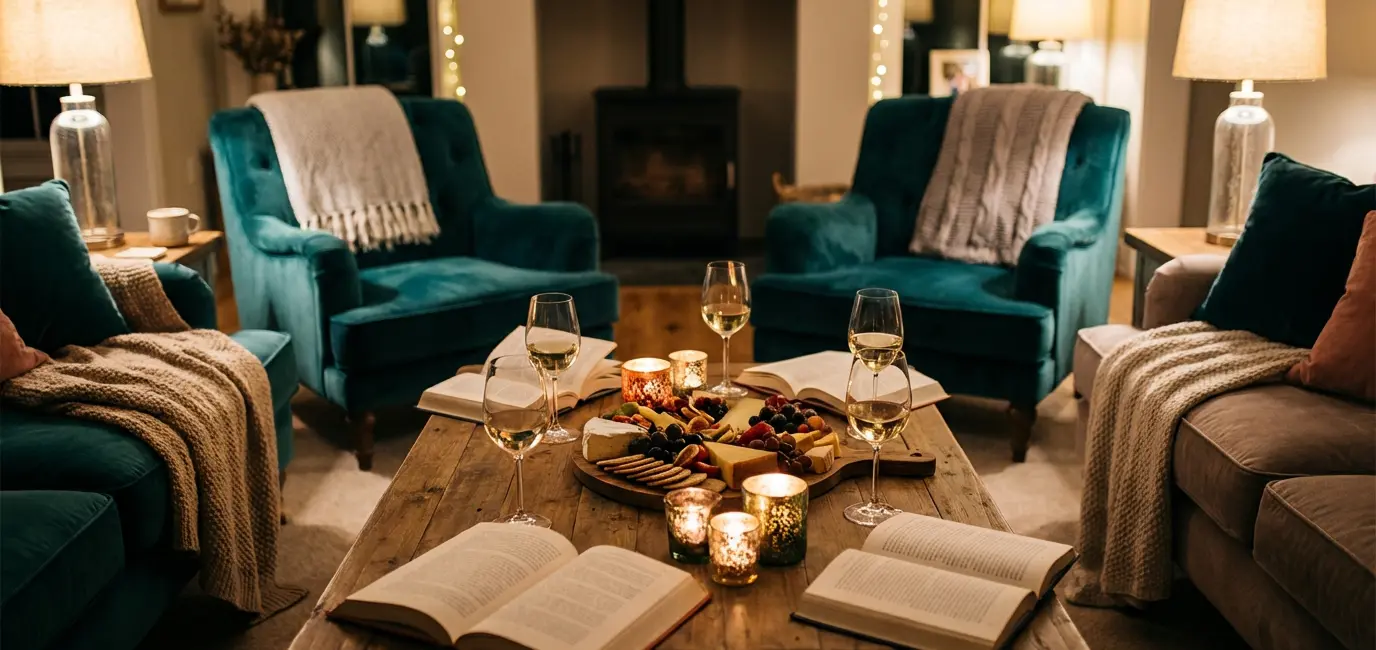
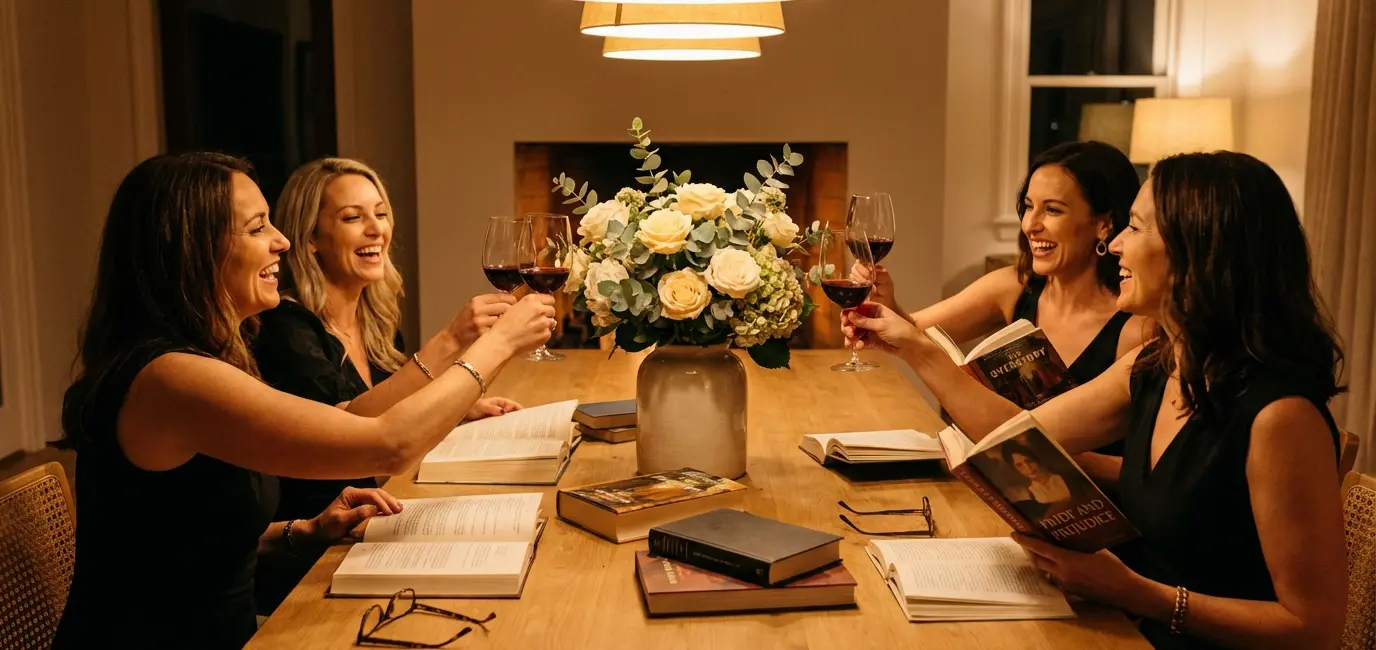
A great book club wine pairing experience is about more than the wine itself. It is about the whole atmosphere — how the room feels, what you eat alongside the wine, how the evening flows from arrival to discussion. Here is the format I have refined over years of hosting.
- One wine per major genre moment, not one wine for the whole evening — if your book has a distinct emotional arc, consider serving two wines: something lighter for the opening discussion (when everyone is still arriving and catching up) and something richer and more complex for the deeper literary conversation. This mirrors the structure of the book itself and keeps the evening feeling intentional rather than arbitrary.
- A curated charcuterie board over anything else — charcuterie is the perfect book club food. It does not compete with any wine style, it requires no cooking timing anxiety, it looks beautiful on a table, and it keeps for the whole evening without becoming sad. A quality charcuterie board from Amazon gives you the right presentation without any effort. Add good bread, one or two cheeses, fruit, and nuts.
- Printed tasting notes for each wine — a simple printed card with the wine name, region, grape variety, and two or three tasting notes turns a casual wine pour into a mini education moment. Your group does not need to be wine experts to appreciate this. It adds a layer of consideration that people always notice.
- A discussion question about the book’s “wine moment” — almost every great novel has a moment where wine or food or a specific sensory detail is used as a pivot point. Making one of your discussion questions about that detail — “Did the dinner party scene in chapter 12 remind you of anything from your own life?” — connects the wine on your table to the book in a way that sparks conversation organically.
- End with dessert and dessert wine — a Moscato d’Asti, a glass of Port, or even a sweet fizz with good chocolate is the perfect way to close the evening. It signals that the formal discussion is over and the social part begins, without anyone having to say it explicitly.
- Consider a subscription wine service for your club — if you want the wine selection taken care of automatically each month, a book-themed subscription box on Cratejoy or a curated wine club gives you a new wine to explore every cycle without the weekly decision fatigue.
For the full hosting setup — from how to arrange the room to what to do when a guest hates the wine selection — our hosting tips for anxious hosts is the guide I wish I had had when I started. And for a broader girls’ night framework that works equally well for book club as for any other occasion, our girls night in ideas guide has the complete format.
Book Club Wine Pairings Resource List: Clubs, Podcasts, and Communities
The book club wine pairing world has its own thriving community of enthusiasts, and there are some genuinely excellent resources that will make your wine-and-book evenings richer.
- Reese’s Book Club — Reese Witherspoon’s picks skew toward female-forward literary fiction and stories of resilience; pair with a quality Chardonnay or rosé as a baseline
- Oprah’s Book Club — the gold standard of mainstream book clubs; picks tend toward emotional depth and social resonance, which calls for full-bodied, expressive reds and whites
- Goodreads Book Clubs — the largest online book community; excellent for finding other people’s genre-matched wine pairing ideas in the discussion threads
- The Book Club Review Podcast — a dedicated podcast covering popular book club picks with detailed discussion questions; find it on Apple Podcasts and Spotify
- What Should I Read Next? (podcast) — Nancy Pearl and Anne Bogel match readers to books based on what they have loved; an excellent source for book club picks when your group is between cycles
- Literary Disco (podcast) — hosted by Rider Strong, Julia Pistell, and Tod Goldberg; intelligent, warm, and genuinely funny literary conversation; excellent pre-book-club listening
- The Maris Review (podcast) — intimate one-on-one author interviews; excellent for deepening your relationship with the book before discussion night
- Wine Club Reviews — independent reviews of wine subscription clubs; useful if you want to find a monthly wine club that aligns with your book club’s reading preferences
- r/bookclub on Reddit — one of the most active online book clubs; discussion threads often include food and drink pairing ideas that are genuinely thoughtful
- Book Riot — bookriot.com regularly publishes genre-specific wine pairing guides and book club resources; a reliable source for the intersection of literary culture and lifestyle
If your interest in pop culture and wine pairings extends beyond books, our Bravo TV show wine pairings guide covers the full franchise-by-franchise breakdown. And if true crime podcasts are part of your regular rotation, our true crime podcast wine pairing guide has the show-by-show recommendations. For building the full wine setup that supports all of these evenings, our complete guide to setting up a home wine bar is the best starting point.
Frequently Asked Questions
What wine goes with a thriller book club?
Pinot Noir, Malbec, or an aged Bordeaux. Thrillers are dark, immersive, and propulsive — your wine should match that energy. Pinot Noir is the most versatile choice: earthy, complex, slightly unpredictable. Malbec for a bolder, more straightforward pick. An aged Bordeaux for slow-burn psychological thrillers that reward patience.
What wine should I bring to a romance book club?
Rosé of Provence is the classic romance book club wine — dry, elegant, beautiful to look at. Moscato d’Asti for sweeter, lighter contemporary romances. Cava or English sparkling for historical romance. You cannot go wrong with anything pink and celebratory.
What wine pairs with literary fiction?
White Burgundy or a quality oaked Chardonnay. Literary fiction is deliberate, layered, and rewarding in proportion to the attention you bring. The wine should be the same: a wine with depth and subtlety that doesn’t demand attention but rewards it. A Grüner Veltliner is a slightly more interesting alternative that works beautifully for challenging contemporary literary fiction.
How do you pick a book club wine if you haven’t read the book?
Read the back cover and identify the genre and dominant emotional register. Match weight to weight — lighter books call for lighter wines, darker books for fuller-bodied reds. When uncertain, a dry rosé or a light Pinot Noir works across almost every genre. You can also ask the person who chose the book how it made them feel — that emotional description is usually enough to make a good pairing choice.
What food should I serve at a book club wine night?
A charcuterie board is the ideal book club food — it requires no cooking timing, works with any wine style, and keeps beautifully throughout an evening. Add good bread, one or two cheeses, fruit, and nuts. The goal is something that sustains conversation without creating a production that distracts from it.
Are there wine clubs specifically for book clubs?
Not wine clubs specifically designed for book clubs, but several monthly wine subscription services curate bottles that pair well with the kind of storytelling and atmosphere that book club evenings create. Cratejoy has a range of wine-adjacent subscription boxes. Wine.com has a wine club service. For a fully curated approach, many book clubs assign the wine pairing to a different member each month — this distributes the fun and often leads to the most interesting choices.
A well-chosen bottle can do for a book club what a great soundtrack does for a film: it does not call attention to itself, but the evening would feel noticeably emptier without it. Whether you are a seasoned host with a full cellar or someone who picks wine at the grocery store ten minutes before guests arrive, the framework in this guide gives you a starting point that will always land better than random. Pick the genre, match the mood, open the bottle, and let the conversation begin. That is all a great book club wine pairing ever really needs to be.