This post may contains affiliate links. Read our full disclosure here.
Knowing how to host a wine tasting at home is one of the most reliably impressive things you can do as a host — and one of the most consistently underestimated. People assume it requires sommelier knowledge, special equipment, or an expensive wine collection. None of that is true. A wine tasting at home is really just a structured version of something you already do: open a few bottles and share them with people you like. The structure is what makes it feel like an event rather than a dinner party where someone brought extra wine. I’ve hosted wine tastings at home for groups from four to twelve, casual and competitive, single varietal and full-flight comparisons, and the format that works every time is simpler than you’d think. This guide covers everything: theme selection, wine sourcing, setup, tasting order, food pairings, how to lead the room, and a set of format ideas that scale to any group.
How to Host a Wine Tasting at Home: Choosing Your Theme and Wines
The single most important decision in how to host a wine tasting at home is the theme — the organizing principle that determines which wines you pour, in what order, and what your guests are comparing. A wine tasting at home without a theme is just open bottles; a wine tasting at home with a clear theme gives every pour context and makes the whole experience more memorable.
The best themes for a wine tasting at home are specific enough to create genuine comparison but broad enough to find interesting bottles at every price point. Here are the formats that work best:
- Single varietal across regions: The same grape from three or four different wine regions — for example, Pinot Noir from Burgundy, Oregon, New Zealand, and California. This is the format I recommend most often for a first wine tasting at home because it isolates one variable (terroir) and produces genuinely surprising results. Guests who assumed all Pinot Noir tastes the same leave the wine tasting at home with a completely different mental model.
- Single region across vintages: The same producer or appellation across three or four years. This format works best when someone in the group has a wine cellar or is curious about how aging changes a wine. It’s the most educational wine tasting at home format and the one that generates the most conversation.
- Blind comparative: Wines poured blind — bottles in paper bags, no labels visible — and guests rank them before the reveal. This is the most game-like format for a wine tasting at home and works particularly well for competitive groups or parties where not everyone is a serious wine enthusiast.
- Price point comparison: Three wines of the same varietal at dramatically different price points — say $15, $40, and $80 — poured blind. The results consistently surprise everyone, including experienced wine drinkers. This is the wine tasting at home format that generates the most laughter and conversation.
- Around the world: One wine from each of five or six major wine regions — France, Italy, Spain, the US, Australia, South America. This format works beautifully for a wine tasting at home with mixed knowledge levels because it covers broad ground and there’s always something for every taste.
For a wine tasting at home with four to six guests, plan on five to six wines with approximately two ounces per pour per wine. That’s roughly one standard bottle per two wines — three bottles for six wines — which leaves enough in each bottle for a second taste of a favorite.
For sourcing wines for your wine tasting at home without spending an afternoon in a specialty shop, Wine.com is the most practical starting point. Their filters let you search by varietal, region, and price simultaneously — exactly what you need when building a flight for a themed wine tasting at home — and their free delivery option means the bottles arrive before you need to chill them.
Setting Up Your Wine Tasting at Home: Glasses, Space, and Supplies
The physical setup for a wine tasting at home is simpler than most people expect. You don’t need specialized equipment or a formal dining room. What you need: enough glasses, a spit bucket or pour-away vessel (more useful than it sounds), a palate cleanser, and a way for guests to record their thoughts. That’s the complete supply list for how to host a wine tasting at home.
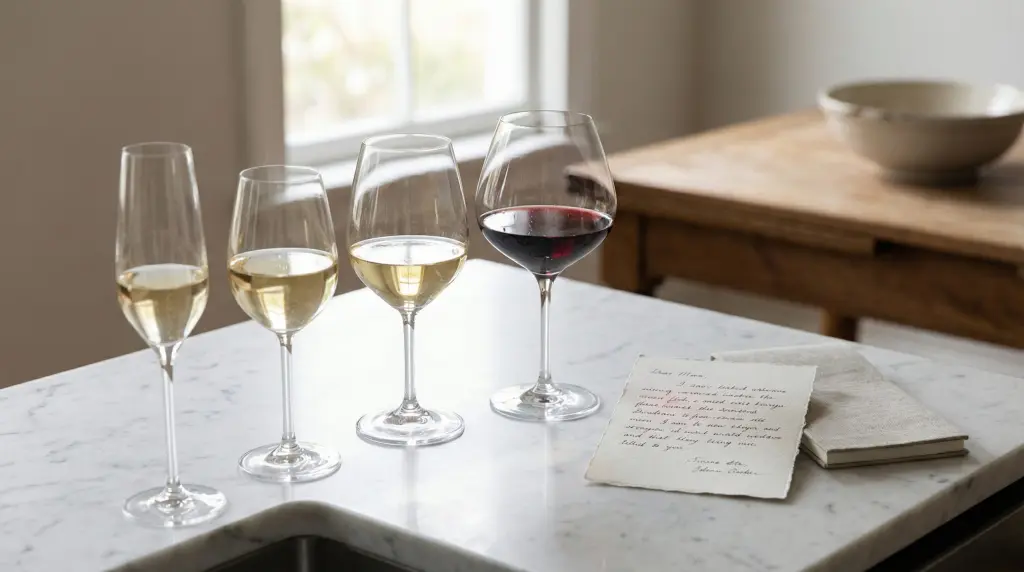
Glasses. The most common setup error in how to host a wine tasting at home is using different glasses for different guests. Identical glasses matter because the shape affects how the wine presents — a guest with a narrow glass and a guest with a wide-bowled glass are technically tasting a different expression of the same wine. For a wine tasting at home, a set of matching mid-range universal wine glasses (the ISO tasting glass shape — narrowing toward the top) is the right choice. You need one glass per guest per wine unless guests are willing to rinse between pours, which most are when the tasting is casual.
- Spittoon or dump bucket: Essential for a wine tasting at home that covers six or more wines. A ceramic bowl or small pitcher on the table gives guests the option to spit or dump remaining pours without disrupting the flow. Even guests who plan to drink everything appreciate the option as the wine tasting at home progresses.
- Water glasses: One per guest, kept full. Palate cleansing between wines is important in a wine tasting at home, and water is the neutral reset that lets guests taste each wine with fresh perception.
- Palate cleansers: Plain unsalted crackers or slices of plain baguette between wines. Nothing flavored, nothing buttered — the goal in a wine tasting at home is neutral cleansing between pours, not eating. Cheese and charcuterie come later.
- Tasting note cards: Printed or handwritten cards with space for each wine’s color, aroma, taste, and score. In a wine tasting at home, having guests write their impressions before discussing them prevents group-think and makes the reveal more interesting. Simple tasting cards can be printed from any template or written on index cards.
- Wine labels or a reveal sheet: For blind tastings, prepare a printed reveal sheet with the wines in order, kept face-down until the scoring is complete. For open tastings, a simple handwritten card beside each bottle is enough.
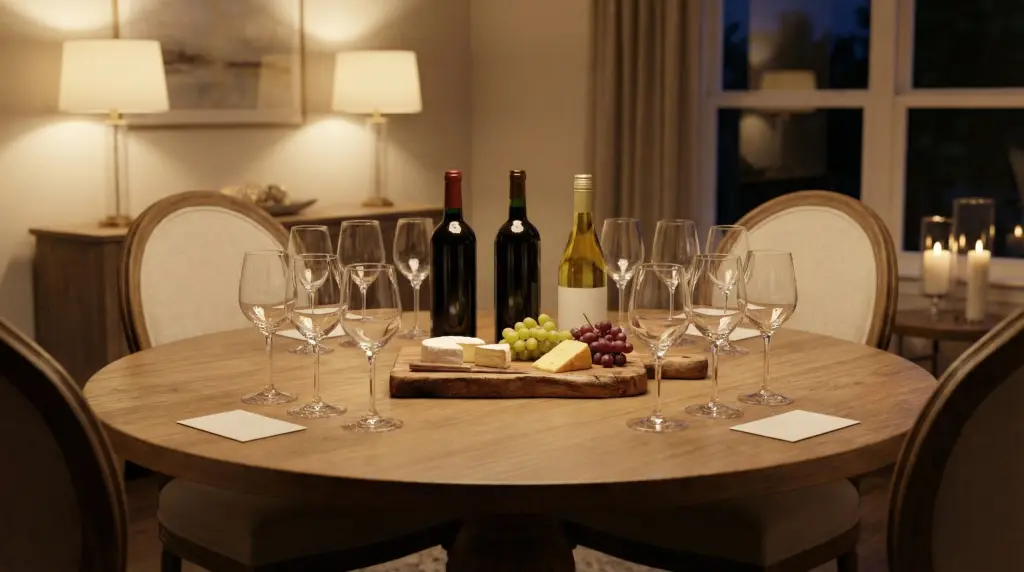
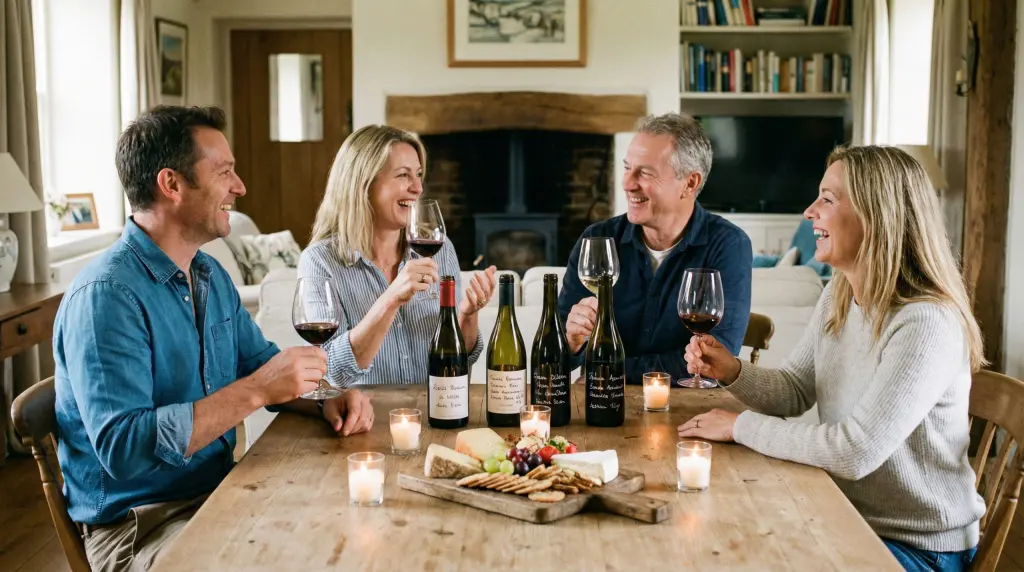
The right arrangement for a wine tasting at home: a round or oval table if possible, with the bottles in the center and each guest’s glasses arranged in a line in front of them in tasting order. This keeps the wine tasting at home organized without requiring any formal service — guests can see all the wines, reach the palate cleansers, and write their notes without standing up.
How to Host a Wine Tasting at Home: The Tasting Order
The tasting order is the structural backbone of how to host a wine tasting at home. Pour wines in the wrong sequence and each wine’s flavor is distorted by what came before it. The correct tasting order for a wine tasting at home follows a few consistent principles regardless of the specific wines:
- Dry before sweet: Always pour dry wines before sweet wines in a wine tasting at home. A sweet wine first makes every subsequent dry wine taste thin and sharp by contrast. Even a slightly off-dry Riesling should come after a bone-dry Chablis.
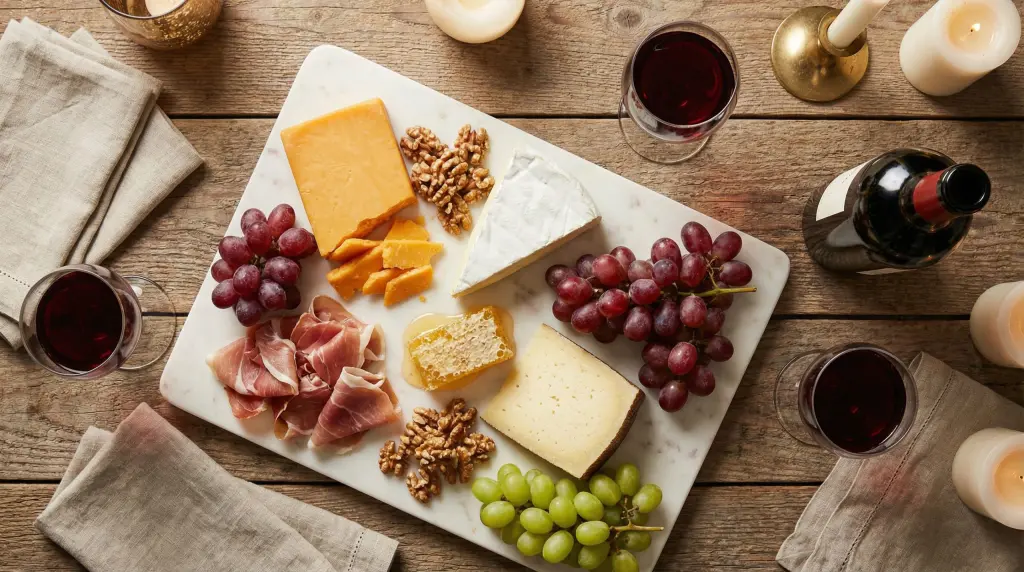
- White before red: In a mixed wine tasting at home, white wines before reds. The lighter body and lower tannins of most whites make them the correct opener — starting with a full-bodied red makes the whites that follow taste watery.
- Light body before full body: Within a category (all reds, or all whites), lighter-bodied wines before fuller-bodied ones. In a wine tasting at home featuring all reds, a Pinot Noir before a Cabernet Sauvignon before a Shiraz is the correct progression.
- Lower alcohol before higher alcohol: Higher-alcohol wines are harder to taste neutrally after you’ve already had them. In a wine tasting at home, saving the highest-alcohol wine for later in the flight keeps earlier wines tasting accurate.
- Younger before older: In a vertical wine tasting at home (same wine across vintages), youngest vintage first. Older wines are more complex and can overwhelm younger wines if poured first.
“The tasting order isn’t a formality — it’s what lets each wine speak for itself. Get it right and the same six bottles feel like a conversation that builds. Get it wrong and the last wines never get a fair hearing.”
For a wine tasting at home that mixes whites and reds in a single-varietal or regional theme: pour all whites first in the correct progression, then move to reds. A palate-cleansing break with water and plain crackers between the white and red flights makes the transition cleaner.
Food Pairings for a Wine Tasting at Home
Food at a wine tasting at home serves a different function than food at a dinner party. The goal is to complement the wines without competing with them — to give guests something to eat between pours that enhances the tasting experience rather than distracting from it. This means keeping the food simple, avoiding strongly flavored or fatty foods during the tasting itself, and saving the more generous spread for after the formal tasting portion.
During the tasting. Plain crackers and bread for palate cleansing. Small pieces of plain water biscuit, unseasoned crostini, or sliced plain baguette. The guiding principle of food at a wine tasting at home during the tasting itself: anything that could change how the next wine tastes shouldn’t be on the table.
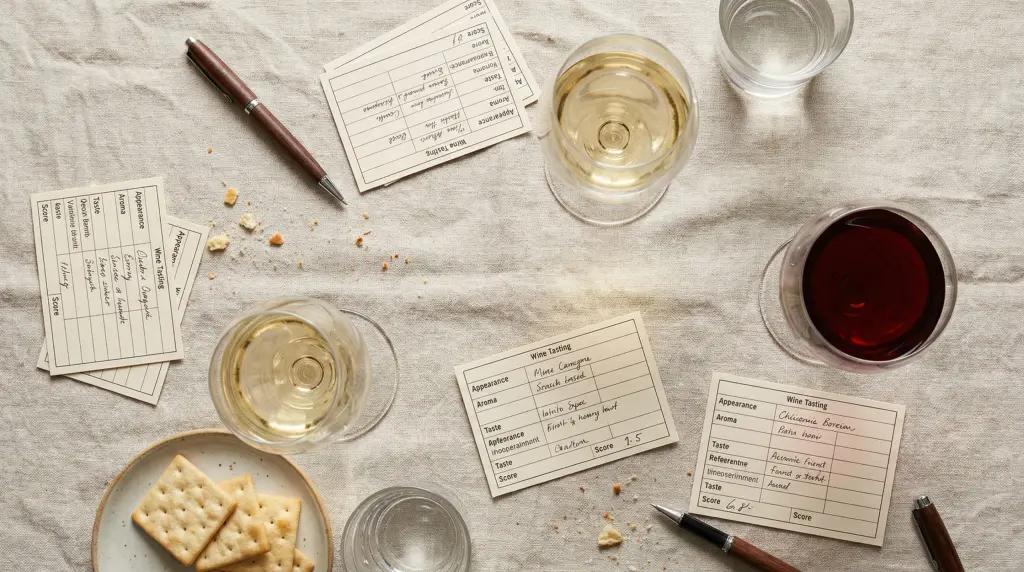
The post-tasting spread. Once the formal flight is complete and the wines are revealed, the wine tasting at home transitions into what is essentially a wine-and-cheese gathering — which is where the food can be more generous and more interesting. The post-tasting board for a wine tasting at home:
- Cheeses, one per wine style: A soft cheese (brie or camembert) for the whites, an aged firm cheese (aged cheddar, manchego, or gruyère) for the medium-bodied reds, and a sharp blue (gorgonzola or stilton) for any full-bodied reds or sweeter wines in the flight. The cheese-pairing approach at a wine tasting at home gives guests a reason to revisit their favorites from the flight.
- Charcuterie: Prosciutto, salami, or jambon de Bayonne. Fatty, savory charcuterie is the natural companion to red wines in the post-tasting portion of a wine tasting at home — the fat softens tannins and makes the wines more approachable.
- Fruit and nuts: Grapes, walnuts, and dried apricots. These elements bridge the cheese, charcuterie, and wine in a way that purely savory elements don’t. A handful of walnuts with a Pinot Noir is one of the underrated pleasures of a wine tasting at home.
- Something sweet: Honeycomb or dark chocolate squares, placed at the end of the board for pairing with any dessert-style wines or bold reds in the flight.
For a wine tasting at home that includes wines covered in the wine and cheese pairing guide, the pairing principles there translate directly to the post-tasting board — the same logic of matching weight, acidity, and sweetness applies whether you’re at a dinner party or a wine tasting at home.
How to Lead the Tasting: Notes, Scoring, and Keeping It Fun
The host’s job in how to host a wine tasting at home is to be a facilitator, not a lecturer. The wine tasting at home works best when guests feel free to form and express their own opinions — which means the host’s role is to guide the structure and ask good questions, not to deliver a monologue about each wine before anyone has tasted it.
The tasting sequence for each wine. For each pour at a wine tasting at home, follow this consistent sequence:
- Look: Ask guests to hold the glass against a white background (a piece of paper or a white tablecloth) and note the color and clarity. At a wine tasting at home, even non-wine people notice that a pale golden wine and a deep amber wine are different before they’ve smelled anything.
- Smell: Nose the wine before tasting. Ask guests to identify one thing they smell — fruit, earth, oak, flowers, spice. At a wine tasting at home, the smell is where the most interesting and individual responses come from. There are no wrong answers.
- Taste: A small sip, held in the mouth for a moment before swallowing or spitting. Ask guests to notice the first impression, the mid-palate, and the finish. How long does the flavor last after swallowing? At a wine tasting at home, finish length is one of the most reliable quality indicators guests can learn to notice.
- Write: Give guests two minutes to write their notes and score the wine before any discussion. This is the step most hosts skip in a casual wine tasting at home, and it’s the step that makes the most difference to the quality of the conversation afterward.
- Discuss: Open the floor. What did people notice? Where do scores differ and why? The best moments of any wine tasting at home come from disagreement about the same wine.
For scoring at a wine tasting at home, a simple 1-to-10 scale per wine is enough. After all wines are tasted and scored, ask each guest for their ranking before the reveal. The discrepancy between individual rankings and the final reveal — especially in a blind or price-point tasting — is where the wine tasting at home becomes genuinely entertaining.
The one rule for how to host a wine tasting at home and keep it fun: no judgment about anyone’s palate. Wine tasting at home is not a test. The guest who consistently prefers the cheapest wine in a blind tasting is not wrong — they have a well-calibrated palate for their own preferences. The wine tasting at home that celebrates every palate as legitimate is the one people want to come back to.
Wine Tasting at Home: Themes and Format Ideas
Beyond the foundational wine tasting at home structure, there are several themed formats that work particularly well for different groups and occasions. Each is a variation on the core wine tasting at home framework with a specific twist that makes the evening feel distinct.
- “Guess the grape” wine tasting at home: All wines poured blind, with guests asked to identify not just their preference but the grape variety. Works best with a group that has some wine knowledge and a competitive streak. The wine tasting at home reveal — where the actual grapes are announced — is the high point of the evening.
- Budget vs. splurge wine tasting at home: Three pairs of wines — a budget and a premium version of the same varietal in each pair — poured blind. Guests rate each wine and guess which is more expensive. This wine tasting at home format consistently produces surprises and tends to run the longest because the conversation about why the cheaper wine won (or didn’t) is irresistible.
- Country theme wine tasting at home: All wines from one country, across regions and varietals. An Italian wine tasting at home covering a Pinot Grigio, a Vermentino, a Chianti, a Barolo, and an Amarone is a complete tour of Italian wine styles in one evening. This wine tasting at home format is educational without feeling like a class.
- Producer spotlight wine tasting at home: Multiple wines from a single winery or producer, covering their different offerings. This format works well when one guest is a fan of a specific producer and wants to share the range. It’s the most personal wine tasting at home format and often generates the most interesting host story.
- Food and wine matching wine tasting at home: Each wine is paired with a specific bite — not a full pairing course, just one element — and guests assess how the food changes the wine. This wine tasting at home format bridges the gap between tasting and dinner and works well with groups who are less focused on the wine itself and more interested in the food connection.
- Natural vs. conventional wine tasting at home: A side-by-side comparison of natural, biodynamic, and conventional versions of the same grape or region. This wine tasting at home format is the most topical and generates the most opinionated conversation — natural wine is a subject that brings out strong preferences in every group.
For any of these wine tasting at home formats, the sourcing principle is the same: clarity of theme, wines at accessible price points (the most interesting wine tasting at home I’ve ever hosted used no bottle over $30), and a host who is more curious than certain. The wine tasting at home that works is the one where the host is genuinely interested in what their guests discover.
If you’re building a broader entertaining practice at home — wine tasting at home as one format among several — the full hosting approach in my dinner party hosting guide and the anxiety-management strategies in my hosting tips for anxious hosts give the wine tasting at home a broader context. The skills transfer directly: the same presence, the same preparation, the same instinct for reading a room.
Frequently Asked Questions About How to Host a Wine Tasting at Home
How many wines should I serve at a wine tasting at home?
Four to six wines is the right range for most wine tastings at home. Below four and the tasting lacks enough variety to generate interesting comparison; above eight and palate fatigue sets in and the later wines don’t get fair attention. For a wine tasting at home with mixed experience levels, five wines — two whites and three reds, or one sparkling, two whites, and two reds — is the format that consistently works best.
How much wine do I need per person for a wine tasting at home?
Plan on approximately 1.5 to 2 ounces per pour per wine. For a wine tasting at home with five wines and six guests, that’s roughly 60 to 80 ounces of wine total — or approximately five standard bottles. In practice, plan for one bottle per two wines in your flight, which gives you a little extra for second tastings of favorites.
Do I need to be a wine expert to host a wine tasting at home?
Absolutely not. The best hosts for a wine tasting at home are curious, not authoritative. Knowing how to introduce each wine (region, grape, a brief note on what to look for) is enough — and that information is available on every bottle’s back label or on the winery’s website. The wine tasting at home is more interesting when the host is discovering things alongside the guests rather than teaching them.
What glasses do I need for a wine tasting at home?
One matching set of universal wine glasses — the ISO tasting glass shape, which narrows toward the top to concentrate aromas — is all you need. For a wine tasting at home with six guests and six wines, you ideally have six glasses per person (one per wine), though most hosts use two to three glasses per person and rinse between flights. Mid-range universal glasses (Riedel Ouverture, Zalto Universal, or the classic IKEA Storsint) work perfectly for a wine tasting at home without requiring a large investment.
Should the wine tasting at home be blind?
A blind wine tasting at home — where bottles are covered and labels aren’t revealed until after scoring — produces more honest assessments and is generally more entertaining, especially for groups with competitive tendencies. An open wine tasting at home, where bottles are visible, is more educational and works better for groups who want to learn about specific regions or producers. Both are legitimate; the choice should be based on what your guests will enjoy most.
The most important thing I’ve learned about how to host a wine tasting at home is that the wines matter less than the format. A carefully structured tasting of six $20 bottles produces a better evening than six random expensive bottles opened without context. Pick a clear theme, establish a tasting order, give guests a way to record their thoughts, and create a genuine reveal moment — those four elements are all that separates a wine tasting at home from an ordinary dinner where someone brought a lot of wine. The wine will take care of itself.